What is a transit? The moving sky meets your birth chart
Your birth chart stays the same for life. Transits are how astrologers compare it with the sky of any day, month or year.
By the AstroScroll editorial team · Updated April 13, 2026 · 6 min read

In short
- A transit is the position of a planet in the sky on a given date, set against your birth chart.
- It counts as a transit when the moving planet forms an aspect to a planet or point in your chart, or passes through one of its houses.
- Fast planets like the Moon and the Sun make transits that pass in hours or days, while Saturn, Uranus, Neptune and Pluto stay near one point for months.
- Astrologers read transits as themes for a stretch of time, not as predictions of events.
On this page
A transit is a planet in the sky of a given day meeting a point in your birth chart. Your birth chart is fixed at the minute you were born, the planets keep moving, and a transit is the name for the time when a moving planet reaches a place that matters in your chart. Astrologers read transits as themes for a stretch of time, not as predictions of events.
What a transit is
Your birth chart is a map of the sky for the minute and place of your birth. It never changes. The sky does.
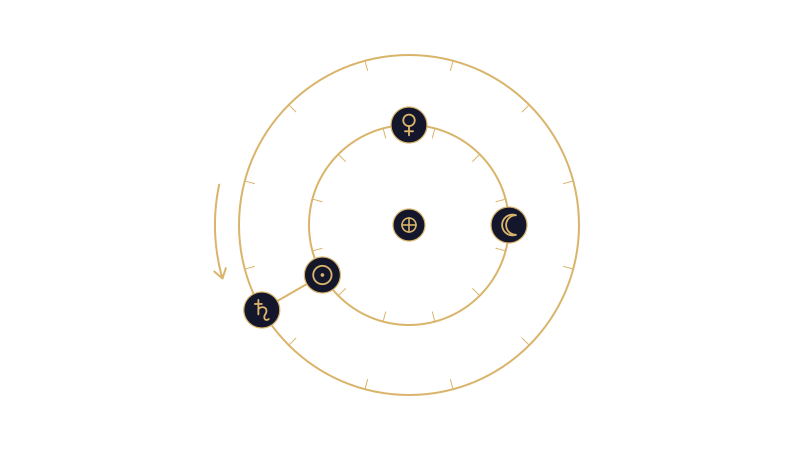
A transit compares the two. Think of the birth chart as a still photograph and of the sky on any later date as a transparent sheet laid over it. Wherever a planet on the moving sheet lines up with something in the photograph, astrologers speak of a transit. There are two kinds.
- A transit to a planet or point. A moving planet forms an aspect, a meaningful angle, to something in your birth chart: a conjunction (0 degrees), a sextile (60), a square (90), a trine (120) or an opposition (180). "Saturn square my Moon" means that Saturn in the sky stands 90 degrees from where the Moon stood when you were born.
- A transit through a house. Houses are the twelve sections of a chart, each linked to an area of life, and they depend on your birth time. "Jupiter in my tenth house" means that Jupiter is passing through the part of your chart linked with career and public role.
Fast and slow planets: how long a transit lasts
What separates one transit from another is, above all, its length.
| Moving body | Time in one sign | Its transits are read as |
|---|---|---|
| Moon | About two and a half days | The mood of a few hours |
| Sun | About 30 days | The focus of a day or two |
| Mercury, Venus | Weeks at a time | Short themes: talks, plans, pleasures |
| Mars | About six to seven weeks, longer when retrograde | Where effort goes for some weeks |
| Jupiter | About one year | An area of growth for some months |
| Saturn | About two and a half years | A longer task: structure, responsibility |
| Uranus | About seven years | Slow change in one area of life |
| Neptune, Pluto | About 14 years, and between about 12 and more than 30 years | Background themes of many years |
The Sun moves about one degree per day and leaves any point of your chart behind within a day or two. A slow planet stays near one degree for months.
Retrograde motion stretches this further. For several months of every year, each slow planet appears to move backward, seen from Earth. No planet really reverses: it is an effect of watching one moving planet from another. A slow planet therefore often crosses the same degree three times, and Saturn often takes about nine months for that. This is why astrologers describe slow transits as periods and not as dates.
Why slow transits are read for the longer themes
Time. A Moon transit is over before you have finished noticing it. A Saturn transit lasts long enough to think something through and act on it.
Rarity. The Moon comes back to every point of your chart about every 27.3 days, the Sun once a year. Saturn returns to the same place only about every 29.5 years, Uranus after 84. Neptune needs about 165 years and Pluto about 248, so neither completes a circle within one human life. Whatever Pluto passes over in your chart, it passes in one period of your life only.
So the slow planets are read as the themes of a year or a stage of life, the fast ones as the days on which such a theme becomes noticeable.
A transit does not say what will happen. It names a theme, and how long that theme stays.
The best-known transits are the returns: a planet coming back to its own birth position. Your birthday is one, because the Sun returns to its birth place once a year. The Jupiter return follows about every twelve years, the Saturn return at about age 29.
See your own chart
Enter your birth date and get your Sun, Moon and Rising sign explained. Free, in about 60 seconds.
I was born on
See my free previewWhere the slow planets are from 2026 to 2028
These positions are the same for everyone. The dates are given in Universal Time and can shift by one day depending on where you live.
| Planet | Sign and dates |
|---|---|
| Jupiter | Cancer until around June 30, 2026, then Leo, Virgo from July 26, 2027 |
| Saturn | Aries from February 14, 2026 to April 12, 2028, Taurus from April 13, 2028 |
| Uranus | Gemini for good from April 26, 2026 |
| Neptune | Aries for good from January 26, 2026 |
| Pluto | Aquarius for good since November 20, 2024 |
What differs from person to person is where these signs fall in the chart. Take Saturn in Aries. If your Sun is in Aries, Saturn passes over it at some point in that span, which is a conjunction. If your Sun is in Libra, Saturn stands opposite it. And for one person Aries covers the fourth house, home and roots, for another the tenth, career. What the twelve houses mean
That is the whole logic of transits: one sky, read against many different charts.
How to read a transit without turning it into a forecast
Three questions are enough for a first reading.
- Which planet is moving, and what does it touch? Jupiter is read as growth, Saturn as structure and responsibility, Uranus as change, Neptune as imagination, Pluto as slow renewal. In your chart, the Sun stands for your sense of self, the Moon for your feelings and needs.
- By which aspect? Trines and sextiles are read as support, squares and oppositions as friction that asks for a decision, the conjunction as emphasis. How aspects are read
- For how long? Days, months or years. This tells you how much weight to give it.
A transit suggests a question worth asking in that period. It does not give the answer, and it is no basis for medical, legal or financial decisions.
What to do next with your own chart
- Get your birth chart and note the sign and degree of your Sun and your Moon.
- Compare them with the table of slow planets. Is one of those planets in the same sign, the opposite sign, or three signs away?
- If so, name the theme in one sentence and ask where in your life it applies.
For a whole year at once, the 2027 Year Ahead Reading compares the moving sky of 2027 with your birth chart, month by month, calculated from your exact birth data.
Questions, answered
What is a transit in astrology?
A transit is a planet's position in the sky on a given date, set against your birth chart. When the moving planet forms an aspect to a planet or point in your chart, or passes through one of its houses, astrologers call that a transit.
How long does a transit last?
That depends on the planet. A Moon transit passes within hours and a Sun transit within a day or two, while Saturn, Uranus, Neptune and Pluto stay near one degree for months and often cross it three times.
Do transits predict what will happen?
No. A transit describes a theme and a time span that astrologers would look at, not an event. What you do in that time is your decision.
Do I need my birth time to read transits?
For transits to your Sun and the planets, the birth date is usually enough. The birth time adds the exact Moon, the Rising sign (also called the Ascendant) and the houses, which show the area of life a transit passes through.
Astrology is a tool for self-reflection, not a science, and it does not replace medical, psychological, legal or financial advice.
Keep reading
Planets & houses
Saturn return: what it is and when yours happens
A Saturn return is when Saturn comes back to where it stood at your birth, at about 29, 58 and 87. What it means, how long it lasts and who has one in 2027.
6 min readRead more →
The year ahead
Solar return chart: your year from birthday to birthday
A solar return chart shows the sky at the moment the Sun returns to its birth position each year. How it is calculated and read, and how transits differ.
6 min readRead more →
The year ahead
The astrology of 2027: the sky of the year at a glance
The sky of 2027 at a glance: Jupiter moves from Leo into Virgo, five eclipses, three Mercury retrogrades, and why your own birth chart decides what it means.
6 min readRead more →
Start with your free preview
I was born on
See my free previewFree preview in 60 seconds · One payment · No subscription
For self-reflection and entertainment. Not medical, psychological, legal or financial advice.