Love
Birth chart compatibility: what two charts show
Why lists of matching signs fall short, what astrologers compare instead, and why your own chart is the honest place to start.
By the AstroScroll editorial team · Updated October 3, 2026 · 6 min read
In short
- Birth chart compatibility means comparing two complete birth charts. Astrologers call this synastry.
- Sun sign lists compare only one point in each chart, so they are a rough sketch at best.
- The comparisons read first are Moon to Moon, Venus and Mars, Sun to Moon, contacts to Saturn and Mercury to Mercury.
- A comparison describes where two people connect easily and where they rub. It does not decide whether a relationship works.
On this page
Birth chart compatibility means comparing two complete birth charts, not two Sun signs. Astrologers call this synastry: the two charts are laid over each other, and the angles between one person's planets and the other's are read. A comparison describes where two people connect easily and where they rub. It does not decide whether a relationship works.
Why Sun sign compatibility lists fall short
A list that says "Aries and Libra: a good match" compares one point in each chart: the position of the Sun. A birth chart also holds the Moon, eight planets and the Rising sign, the sign on the eastern horizon at birth (also called the Ascendant).
Most of these lists rest on the four elements. Fire signs (Aries, Leo, Sagittarius) and air signs (Gemini, Libra, Aquarius) are said to get along, and so are earth signs (Taurus, Virgo, Capricorn) and water signs (Cancer, Scorpio, Pisces). As a rule of thumb about temperament, that is not wrong. It is just very coarse.
About one person in twelve shares your Sun sign. A list treats all of them as the same partner. In real charts, two people with "incompatible" Sun signs can have their Moons in the same sign and Venus and Mars in close contact. Two people with a "perfect" Sun sign match can have little else that connects them.
What astrologers compare instead: synastry
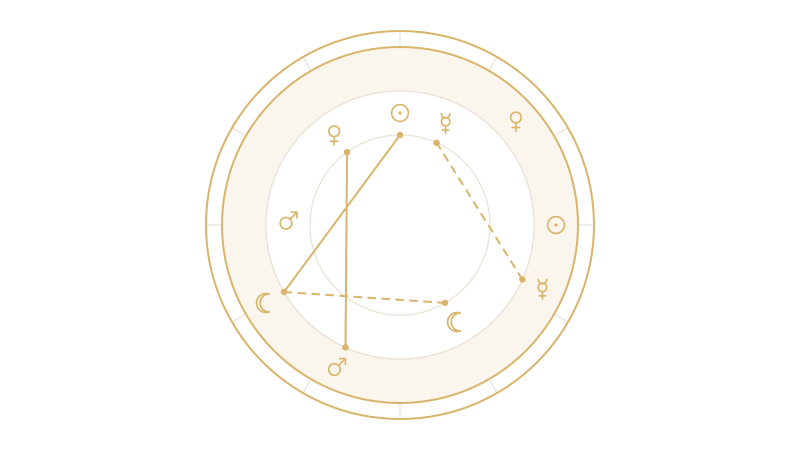
Synastry is the comparison of two birth charts. Picture two chart wheels, one drawn inside the other, both lined up on the same zodiac. Every planet of one person now has a position relative to every planet of the other.
Astrologers look at two things.
- Aspects between the two charts. An aspect is an angle between two planets. A conjunction (0 degrees) puts two planets in the same place and blends them. The sextile (60 degrees) and the trine (120 degrees) are read as easy contacts, the square (90 degrees) and the opposition (180 degrees) as tense ones.
- Planets in the other person's houses. The houses are the twelve sections of a chart, each linked to an area of life. Where your partner's planets land in your houses shows which part of your life they touch most. This needs an exact birth time. The twelve houses explained
The closer an aspect is to its exact angle, the more weight it gets. A handful of close contacts says more than a long list of loose ones.
The most important comparisons in synastry
| Comparison | What it describes |
|---|---|
| Moon to Moon | Emotional rhythm: whether you calm down, recharge and feel at home in similar ways. |
| Venus and Mars | Attraction: what one person finds appealing meets the way the other pursues. |
| Sun to Moon | Feeling understood: one person's core meets what the other needs. |
| Saturn contacts | Staying power and friction: commitment and responsibility, and the feeling of being limited. |
| Mercury to Mercury | How you talk: pace, humor, and how you sort out a disagreement. |
Two notes on the table. Contacts run in both directions: your Venus to their Mars is a different contact from their Venus to your Mars. And the Moon moves quickly, about one sign every two and a half days, so for the Moon comparisons it helps to know both birth times.
Saturn deserves a word of its own. It stands for structure, limits and the things that take time. When one person's Saturn touches the other's Sun, Moon or Venus, astrologers read it as glue: seriousness, loyalty, a sense of responsibility for each other. The same contact can feel like being criticized or held back. Both readings belong to it.
See your own chart
Enter your birth date and get your Sun, Moon and Rising sign explained. Free, in about 60 seconds.
I was born on
See my free previewWhat "difficult" aspects really mean
Squares and oppositions between two charts have a bad reputation they do not deserve. A tense aspect marks a topic where two people work differently and have to find an arrangement.
Take a Moon in Aries and a Moon in Cancer, two signs that stand in a square. One person gets over an upset quickly and wants to move on. The other needs time and reassurance first. That is friction. It is also something two people can learn about each other and plan for.
Easy aspects are pleasant. Astrologers often note that a comparison made only of easy aspects can describe a comfortable bond with little pull. Tension is where much of the energy between two people comes from.
A difficult aspect names a topic you will have to talk about. It does not tell you how the talk ends.
What a chart comparison cannot do
- It does not decide whether a relationship works. People do, through how they treat each other, what they want and what they are willing to work on.
- It does not give a score. A comparison shows several topics at once, some easy and some hard. A single percentage cannot hold that.
- It does not excuse behavior. "That's just my Scorpio Moon" may explain a tendency. It does not make unkindness acceptable.
- It does not make the decision for you. Whether to start, stay or leave is yours to decide. A chart can give you words for what you already notice.
A chart also knows nothing about the history two people share, their values or their circumstances. It is a tool for reflection, not a verdict.
The honest first step: your own chart
Before you compare two charts, understand one. Much of what people look for in a compatibility check is really a question about themselves: what do I need, what do I keep choosing, what do I find hard to say?
- Your Moon. It describes what you need to feel safe with someone. How to find your Moon sign
- Your Venus. It describes how you love and what attracts you. What your Venus sign means
- Your Mars. It shows how you go after what you want and how you handle conflict.
- Your seventh house, if you know your birth time. It is the house of partnership.
A Love Reading covers this for one chart: yours. It is calculated from your exact birth data and describes how you love. It does not compare two people.
Once you know your own chart, a comparison becomes more useful. Ask the other person for their birth data rather than guessing, read their Moon and Venus with the same care as your own, and treat what you find as the start of a conversation.
Questions, answered
What is synastry?
Synastry is the comparison of two birth charts. The charts are laid over each other, and the angles between one person's planets and the other person's planets are read.
Are our signs compatible?
Your Sun signs are one point out of many. Two people whose Sun signs are said not to match can have close contacts between their Moons, Venus and Mars, and the reverse is just as possible.
Do we both need our birth times to compare charts?
The planets in their signs can be compared without birth times. The Moon changes sign about every two and a half days, so it can be uncertain, and the Rising signs and houses need exact birth times.
Can a chart comparison tell us whether to stay together?
No. It describes tendencies between two people. Whether a relationship works depends on what both of you do, and that decision is yours.
Astrology is a tool for self-reflection, not a science, and it does not replace medical, psychological, legal or financial advice.
Keep reading

Love
Venus sign meaning: how you love
Your Venus sign shows how you love, what you find beautiful and what you value. What all twelve Venus signs mean, and why yours is always near your Sun sign.
6 min readRead more →
Sun, Moon & Rising
What is my Moon sign?
Your Moon sign is the zodiac sign the Moon was in when you were born. It describes your feelings and needs. What it means, and what you need to find yours.
6 min readRead more →
Planets & houses
The 12 houses in astrology, explained
The 12 houses in astrology are twelve areas of life, counted from your Rising sign. What each house means, what an empty house says, and why birth time matters.
6 min readRead more →
Start with your free preview
I was born on
See my free previewFree preview in 60 seconds · One payment · No subscription
For self-reflection and entertainment. Not medical, psychological, legal or financial advice.