Solar return chart: your year from birthday to birthday
Once a year the Sun comes back to the exact place it had when you were born. The chart of that moment is read as a picture of the year that follows.
By the AstroScroll editorial team · Updated July 22, 2026 · 6 min read

In short
- A solar return is the moment each year when the Sun returns to the exact position it had at your birth.
- It falls on your birthday or on the day before or after, at a different clock time every year.
- A solar return chart is the chart of the sky for that moment, and astrologers read it for the year from one birthday to the next.
- It is one chart for one year, while transits follow the moving sky day by day, and it describes themes, not events.
On this page
A solar return chart is a chart of the sky for the exact moment the Sun returns to the position it had when you were born. That happens once a year, on your birthday or the day before or after. Astrologers read this chart as a picture of your year from one birthday to the next: its themes and its emphasis, not a forecast of events.
What a solar return is
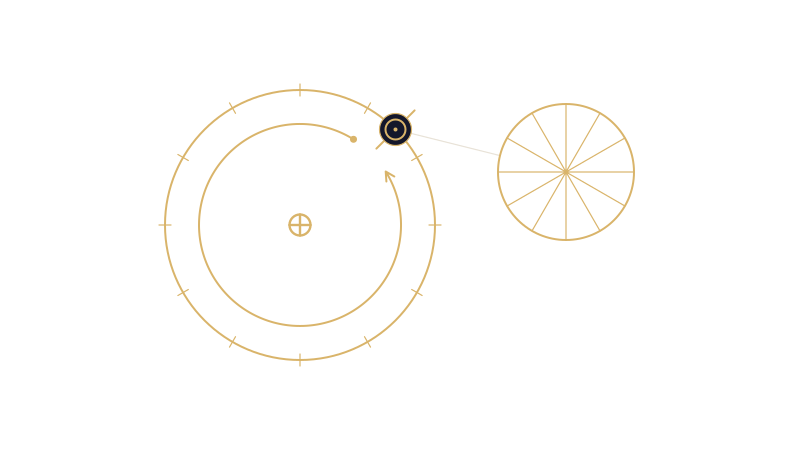
Seen from Earth, the Sun moves through the whole zodiac once a year, about one degree per day. Your birth chart records the exact place where it stood at your birth: its sign, its degree and the fraction of a degree. Once a year the Sun reaches that exact place again. This moment is your solar return.
It is close to your birthday, but it is not midnight on your birthday. The Sun's circle does not take a whole number of days, which is why the calendar needs leap years. So the moment of return comes at a different clock time every year, and sometimes on the day before or after your birthday. It is one moment for the whole world, and the date on the calendar depends on your time zone.
A solar return chart, also called a birthday chart, is calculated for this one minute. The Sun in it has the same sign and degree as in your birth chart. Everything else is new: the Moon, the planets, the Rising sign and the houses.
How a solar return chart is calculated
Three things go into it.
- The exact position of your birth Sun. It comes from your date and time of birth. Without a birth time the Sun's position is uncertain by up to about one degree, and the moment of the return by up to about a day.
- The year. There is one solar return for each year of your life.
- The place. Here astrologers differ. Some use the place where you are at the moment of the return, others your place of birth.
The place and the minute decide the Rising sign (also called the Ascendant), the sign coming up on the eastern horizon, and with it the twelve houses. The Rising point moves through all twelve signs in 24 hours, about one degree every four minutes. This is why a solar return chart is sensitive to an exact birth time. How to find your birth time
What can and cannot change from year to year:
- Sun: always the same sign and degree as at birth.
- Mercury: in your Sun sign or a neighboring sign, because it stays within about 28 degrees of the Sun.
- Venus: in your Sun sign or one of the two signs before or after it.
- Moon and the other planets: wherever they stand at that moment.
- Rising sign and houses: new every year.
What astrologers read in a solar return chart
Most readings start with three things.
- The Rising sign of the year. It is read as the tone of the year: how you approach things for these twelve months. What a Rising sign describes
- The house of the Sun. Houses are the twelve sections of a chart, each linked to an area of life. The house the Sun falls in is read as the main focus of the year.
- The Moon. Its sign and house are read as what you need in order to feel settled in that year.
| Sun in house | Focus astrologers read for the year |
|---|---|
| 1 | Yourself and how you appear |
| 2 | Money and what you value |
| 3 | Learning, communication, siblings |
| 4 | Home and roots |
| 5 | Creativity, play, romance, children |
| 6 | Daily work, routines, health habits |
| 7 | Partnership |
| 8 | Intimacy, shared resources, change |
| 9 | Travel, study, beliefs |
| 10 | Career and public role |
| 11 | Friends, groups, hopes |
| 12 | Rest, retreat, the inner world |
An example: in one year the solar return chart has Libra rising and the Sun in the eleventh house. Astrologers would read a year approached with tact and a wish for balance, with friends and groups in focus. Twelve months later the same person may have Capricorn rising and the Sun in the eighth house, and the reading changes with it.
A solar return chart is never read on its own. It is set beside your birth chart, which stays the basis.
Your birth chart is the book. A solar return chart is one year's page in it.
See your own chart
Enter your birth date and get your Sun, Moon and Rising sign explained. Free, in about 60 seconds.
I was born on
See my free previewSolar return and transits: what is the difference?
Both compare a later sky with your birth. They do it in different ways. A transit is a moving planet meeting a point in your birth chart, and transits are followed through time.
| Solar return chart | Transits | |
|---|---|---|
| What it is | One chart for one moment | The moving sky, set against the birth chart |
| Period | From birthday to birthday | Any day, month or year |
| Strength | The emphasis of a year at a glance | When a theme begins and how long it stays |
| Birth time | Needed for Rising sign and houses | Needed mainly for the houses |
Many astrologers use both: the solar return for the overall picture, the transits for the timing. Neither one predicts what will happen. Both describe themes, and what you do with them is yours.
One thing to keep apart: the 2027 Year Ahead Reading works with transits. It compares the moving sky of 2027 with your birth chart, month by month, for the calendar year. It is not a solar return chart.
What to do with your solar return
- Make sure of your birth time first. A few minutes change the Rising point of the chart.
- Look at three things only: the Rising sign of the year, the house of the Sun and the Moon.
- Put the focus into one sentence, for example: "This is a year about home."
- Write down one question for the year and read it again on your next birthday.
Treat it as a yearly moment to pause, not as a schedule. It is no basis for medical, legal or financial decisions.
Questions, answered
What is a solar return chart?
It is a chart of the sky for the exact moment the Sun returns to the position it had at your birth. That happens once a year, and the chart is read as a picture of your year from birthday to birthday.
Is my solar return always on my birthday?
It falls on your birthday or on the day before or after. The Sun's circle does not take a whole number of days, so the exact moment comes at a different clock time each year.
Which place do I use for a solar return chart?
Astrologers differ. Some calculate it for the place where you are at the moment of the return, others for your place of birth. The place changes the Rising sign and the houses of the chart, not the signs of the planets.
Do I need my birth time for a solar return chart?
Yes, if you want its Rising sign and houses. The Sun moves about one degree per day, so without a birth time the moment of the return is uncertain by up to about a day.
Astrology is a tool for self-reflection, not a science, and it does not replace medical, psychological, legal or financial advice.
Keep reading

The year ahead
What is a transit? The moving sky meets your birth chart
A transit is a planet in the sky of a given day meeting a point in your birth chart. How fast and slow transits differ and how astrologers read them.
6 min readRead more →
The year ahead
Jupiter return: every twelve years, a new round of growth
A Jupiter return is when Jupiter comes back to where it stood at your birth, around ages 12, 24, 36, 48, 60 and 72. What it means and how to find yours.
6 min readRead more →
Planets & houses
The 12 houses in astrology, explained
The 12 houses in astrology are twelve areas of life, counted from your Rising sign. What each house means, what an empty house says, and why birth time matters.
6 min readRead more →
Start with your free preview
I was born on
See my free previewFree preview in 60 seconds · One payment · No subscription
For self-reflection and entertainment. Not medical, psychological, legal or financial advice.