
How to find your birth time
Six places where a birth time is written down, how exact it has to be for a birth chart, and what still works without one.
By the AstroScroll editorial team · Updated January 29, 2026 · 6 min read

In short
- The most reliable source for a birth time is the full, long-form version of your birth certificate or the birth register it is based on.
- If the time is not there, ask the hospital where you were born, then your family, and look through baby books, keepsakes and health records from the birth.
- The Rising point moves about one degree every four minutes, so a time within a few minutes is ideal and a time rounded to the quarter hour is usually enough for the Rising sign.
- Without a birth time a chart still works: it leaves out the Rising sign and the houses, and the planets keep their signs.
On this page
The most reliable source for your birth time is the full, long-form version of your birth certificate, or the birth register it is based on. If the time is not there, ask the hospital where you were born, then your family, and look through baby books and keepsakes. For a birth chart the time should be as exact as you can get it, because the Rising sign changes about every two hours.
Where to find your birth time: six places to look
Start with records written down at the time. They beat memory.
- Your birth certificate, long form. Many places issue two versions: a short one with name, date and place, and a full copy of the original entry. A recorded time is usually on the long version only. If your copy shows no time, request the full version and say clearly that you need the time of birth.
- The birth register. A certificate is an extract from a register kept by the vital records office or civil registry for the place where you were born. That office can often issue a complete copy of the entry. What is recorded and who may request it differs by country and state.
- The hospital. Hospitals and birth centers note the time of delivery in their files. Ask the records department. How long such files are kept differs widely, so this works best for more recent births.
- Your parents and relatives. Ask everyone who was there or was called that day. Ask for anchors, not only for a number: Was it light or dark outside? Before or after a meal? Who was phoned, and were they asleep? Two memories that agree are worth far more than one.
- Baby book and keepsakes. Look at baby books, birth announcement cards, the hospital wristband, the back of the first photo, a diary from that week. Parents often wrote the time down exactly once, in a place like this.
- Health records from the birth. The booklets and papers a mother and a newborn are given around the birth sometimes include the time of delivery.
Why the birth time matters for a birth chart
Most of a birth chart depends on your date of birth. The Sun and the planets stay in a sign for many days at a time, the Moon for about two and a half. Three parts depend on the clock.
The Rising sign, also called the Ascendant, is the sign that was coming up on the eastern horizon at the moment you were born. Because the Earth turns once a day, all twelve signs rise within 24 hours, on average one sign every two hours. At the Rising point the houses begin, the twelve sections of a chart that stand for areas of life. And the Midheaven, the highest point of the zodiac at that moment, moves at a similar pace.
| Part of the chart | Do you need the birth time? |
|---|---|
| Sun sign | Only if you were born on a day the Sun changes signs |
| Moon sign | Only on a day the Moon changes signs, which happens about every two and a half days |
| Signs of the planets | Only on the rare day a planet changes signs |
| Rising sign | Yes. It changes about every two hours |
| Midheaven | Yes |
| Houses | Yes. They begin at the Rising point |
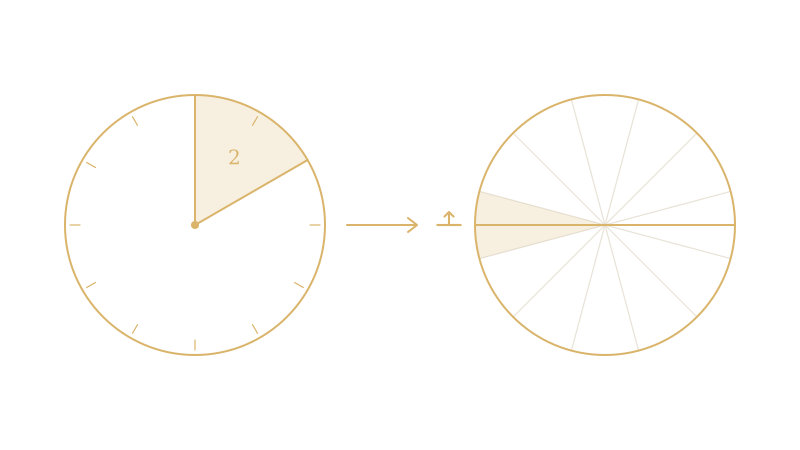
The date gives you the signs of your planets. The time gives you your Rising sign, the twelve houses and the Midheaven, which is read for career and public role.
A birth date tells you where the planets stood. Only the birth time tells you which way the sky was turned.
See your own chart
Enter your birth date and get your Sun, Moon and Rising sign explained. Free, in about 60 seconds.
I was born on
See my free previewHow exact your birth time needs to be
The Rising point moves about one degree every four minutes, and a sign has 30 degrees. These two numbers show what an uncertain time does to a chart.
- Exact to a few minutes. The Rising sign, the houses and the Midheaven can be read as calculated.
- About 15 minutes off. The Rising point shifts by about four degrees. The Rising sign stays the same in most cases, and a planet close to a house border may move into the neighboring house.
- About an hour off. The Rising point shifts by about 15 degrees, half a sign. The Rising sign may be a different one, and the houses move with it.
- Only "in the morning" or "at night". The planets keep their signs. The Rising sign and the houses cannot be relied on.
Recorded times are often rounded, for example to the nearest five minutes. That is exact enough, unless the calculated Rising point lies in the first or last degrees of a sign. Then read the neighboring sign as well.
Common mistakes with birth times
- Morning and evening mixed up. A 12-hour error moves the Rising point about halfway around the zodiac. Check whether a noted 7:30 means morning or evening.
- Converting the time. Use the local clock time at the place of birth, exactly as recorded. The place tells the calculation which time zone applied. Do not convert the time to the zone you live in now, and do not add or subtract an hour for daylight saving time yourself.
- Family legend. A time repeated for decades can still be two hours off. Treat it as approximate until a record confirms it.
What to do if you cannot find your birth time
Some birth times were never written down, and some records no longer exist. You still have options.
- Use a chart without a time. It leaves out the Rising sign and the houses, and the planets keep their signs. The guide to a birth chart without a birth time shows what stays and what goes.
- Work with a window. If you know "early morning" or "just after dinner", a window of two or three hours often leaves only two or three possible Rising signs. Read their descriptions and keep the one that fits as a working guess.
- Know what rectification is. Some astrologers estimate a birth time from the dates of important life events. The result is an estimate, not a record.
- Do not invent a time. Noon as a placeholder produces a Rising sign and houses that look real and mean nothing.
What to do next
- Check the documents you already have at home, including your parents' folders.
- Request the full copy of your birth record and mention the time of birth.
- While you wait, ask your family and write down what each person remembers.
- Once you have a time, enter it exactly as recorded and look at your Rising sign first.
A Birth Chart Reading is calculated from your exact birth data. Without a time it still works and leaves out the Rising sign and the houses.
Questions, answered
Is my birth time on my birth certificate?
Sometimes. Many places issue a short version without the time and a long version that includes it. Records differ by country and state, so ask for the full or long-form copy and say that you need the time of birth.
How accurate does my birth time need to be?
As exact as you can get it. The Rising point moves about one degree every four minutes and the Rising sign changes about every two hours, so an error of an hour can already change the Rising sign.
What if nobody knows my birth time?
You can still have a chart calculated. The Sun, the Moon and the planets keep their signs, and only the Rising sign and the houses are left out. Do not enter a guessed time and read the result as fact.
Can an astrologer work out my birth time?
Some astrologers estimate a birth time from the dates of important life events, a method called rectification. The result is an estimate, not a record, and should be treated as one.
Astrology is a tool for self-reflection, not a science, and it does not replace medical, psychological, legal or financial advice.
Keep reading

Birth chart basics
A birth chart without a birth time
Yes, a birth chart works without a birth time. The planets keep their signs, but the Rising sign and houses are missing. Plus: how to find your birth time.
6 min readRead more →
Sun, Moon & Rising
What is my Rising sign?
Your Rising sign is the zodiac sign on the eastern horizon at the minute you were born. What it means, what you need to find it, and why your birth time matters.
6 min readRead more →
Birth chart basics
What is a birth chart?
A birth chart is a map of the sky at the exact minute and place you were born. What it shows, what you need to calculate one, and how to start reading yours.
6 min readRead more →
Start with your free preview
I was born on
See my free previewFree preview in 60 seconds · One payment · No subscription
For self-reflection and entertainment. Not medical, psychological, legal or financial advice.