
Birth chart basics
A birth chart without a birth time
Most of your chart does not depend on the hour. Here is what stays, what drops out, and where the missing time can often still be found.
By the AstroScroll editorial team · Updated October 3, 2026 · 6 min read

In short
- A birth chart can be calculated without a birth time. Your birth date is enough for the Sun sign, the signs of all the planets and the aspects between them.
- Missing without a birth time are the Rising sign, the twelve houses and the Midheaven, because they change within minutes and hours.
- The Moon is the special case: it changes sign about every two and a half days, so on some birthdays two Moon signs are possible.
- In the United States the long-form birth certificate often lists the time of birth. Hospital records and family papers are the next places to look.
On this page
Yes, you can have a birth chart without a birth time. Your date of birth is enough to place the Sun and the planets in their signs and to calculate the angles between them. What is missing without a time are the Rising sign, the houses and the Midheaven, and on some birthdays the Moon sign stays open between two signs.
What a birth chart shows without a birth time
Most of a chart moves so slowly that the hour of birth makes no difference.
- Your Sun sign. The Sun moves about one degree a day and changes sign about every 30 days. Only if you were born on the day of a change does the time decide.
- Mercury, Venus and Mars. Their signs describe how you think and talk, how you love, and how you go after what you want. The date fixes them, except on the few days when one of them changes sign.
- Jupiter, Saturn, Uranus, Neptune and Pluto. Jupiter stays in a sign for about a year, Saturn for about two and a half years, the outer three for much longer. Apart from the rare day of a change, their signs are certain.
- The aspects between the planets. Aspects are the angles between two planets, such as 90 or 120 degrees. The planets barely move within one day, so these angles hold whatever the hour was.
That is far more than a Sun sign: it is the larger part of a chart.
What is missing, and why
Three things depend not on the slow planets but on the daily turn of the Earth, and that is fast.
- The Rising sign, also called the Ascendant: the sign coming up over the eastern horizon at the minute of your birth. It changes about every two hours.
- The houses: twelve sections of the chart that begin at the Rising point and stand for areas of life such as home, work and partnership. Without them a chart can say that your Venus is in Taurus, but not which area of life it belongs to.
- The Midheaven: the highest point of the chart, read for career and public role.
Within 24 hours all twelve signs rise once, so the date alone cannot narrow it down. More in our guide to what the Rising sign is and why it moves so fast.
One practical warning: some chart calculators quietly fill in noon when you leave the time empty. The wheel then shows a Rising sign and houses that describe noon on your birthday, not you. Ignore them.
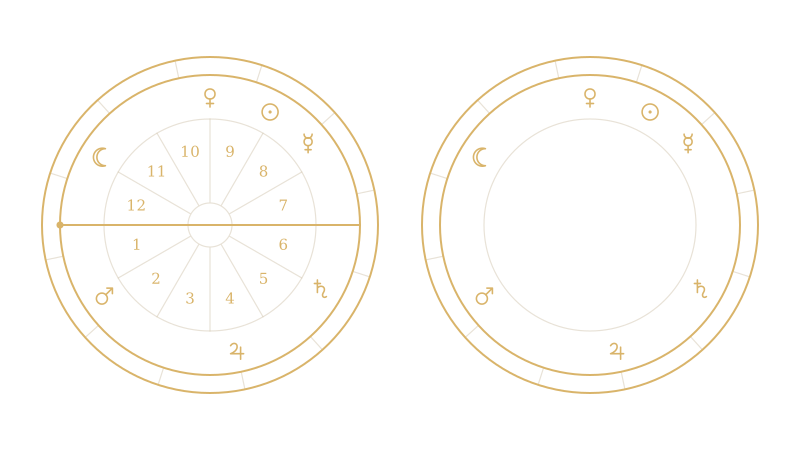
The special case: your Moon sign
The Moon is the one body in the chart that is fast enough for the hour to matter. It moves about 13 degrees a day. A sign is 30 degrees wide, so the Moon changes sign about every two and a half days.
So on about one day in two and a half, the Moon changes sign at some point during the day. If you were born on such a day, both signs are possible without a birth time. On all other days your Moon sign is certain.
If yours is one of the open cases, two things help:
- A rough time is often enough. If the Moon changed sign in the early morning and you know you were born in the evening, the question is settled.
- Read both descriptions. The Moon sign describes what you feel and what you need to feel at home. Most people recognize themselves clearly in one of the two. Here is what your Moon sign means.
Because the Moon's exact degree is unknown without a time, its aspects to the planets are less reliable than the rest.
Without a birth time you lose the frame of the chart, not the picture.
See your own chart
Enter your birth date and get your Sun, Moon and Rising sign explained. Free, in about 60 seconds.
I was born on
See my free previewWith and without a birth time: what you get
| Part of the chart | With a birth time | Without a birth time |
|---|---|---|
| Sun sign | Exact | Exact, unless the Sun changed sign that day |
| Moon sign | Exact | Certain on most days, two signs possible on a day of change |
| Signs of Mercury, Venus and Mars | Exact | Exact, except on a day of change |
| Signs of Jupiter through Pluto | Exact | Exact, except on the rare day of a change |
| Aspects between the planets | Exact | Reliable, those of the Moon less so |
| Rising sign | Yes | Not possible |
| Houses | Yes | Not possible |
| Midheaven | Yes | Not possible |
An AstroScroll reading follows the same logic. Without a birth time it still works: it leaves out the Rising sign and the houses and reads everything else. More on the page for the Birth Chart Reading.
How to find your birth time
For people born in the United States, these are the usual places to look:
- The long-form birth certificate. The long form is the full copy of the original record and often lists the time of birth. The short version usually does not.
- The vital records office. If you only have the short version, ask the vital records office of the state where you were born for the long form. Older records do not always contain a time.
- The hospital. The hospital where you were born may still hold the birth record, though old files are not always kept.
- Family papers. A baby book, a birth announcement or a hospital bracelet may note the time.
- Parents and relatives. Ask the people who were there, but keep in mind that remembered times are often rounded to the hour.
If you were born in another country, the civil registry of your birthplace is the first place to ask.
How exact does it have to be?
The Rising point moves about one degree every four minutes. A birth time that is a few minutes off rarely changes your Rising sign, unless the sign was just about to change. An hour off can change it and shift planets into other houses. When a document and a memory disagree, use the document.
If no record exists
Astrologers have a technique called rectification. It works backward from dated events in a person's life to estimate a birth time. The result is an estimate, not a record, and two astrologers can arrive at different times. Treat a rectified time as a working assumption.
What to do next with your chart
Start with what is certain. Your Sun sign, your planets in their signs and the aspects between them already describe a great deal: how you think, love and act. If you are new to this, begin with what a birth chart is and how its parts fit together.
In the meantime, request the record. If the time turns up, the Rising sign and the houses are added to your chart, and nothing you have read before becomes wrong.
Questions, answered
Can I get a birth chart without my birth time?
Yes. The Sun and the planets can be placed in their signs from your birth date alone, and the aspects between them can be calculated. The chart then leaves out the Rising sign, the houses and the Midheaven.
Can I find my Rising sign without a birth time?
No. All twelve signs rise over the horizon within 24 hours, so without a birth time every Rising sign is possible. A chart drawn for noon shows a Rising sign, but it describes noon, not you.
How do I find out what time I was born?
Start with the long-form version of your birth certificate, which often lists the time. If it does not, ask the vital records office of the state you were born in, the hospital, and your family. Baby books and birth announcements often note the time.
How accurate does my birth time need to be?
The Rising point moves about one degree every four minutes. A few minutes rarely change your Rising sign, but an error of an hour can change it and move planets into other houses.
Astrology is a tool for self-reflection, not a science, and it does not replace medical, psychological, legal or financial advice.
Keep reading

Sun, Moon & Rising
What is my Rising sign?
Your Rising sign is the zodiac sign on the eastern horizon at the minute you were born. What it means, what you need to find it, and why your birth time matters.
6 min readRead more →
Sun, Moon & Rising
What is my Moon sign?
Your Moon sign is the zodiac sign the Moon was in when you were born. It describes your feelings and needs. What it means, and what you need to find yours.
6 min readRead more →
Birth chart basics
What is a birth chart?
A birth chart is a map of the sky at the exact minute and place you were born. What it shows, what you need to calculate one, and how to start reading yours.
6 min readRead more →
Start with your free preview
I was born on
See my free previewFree preview in 60 seconds · One payment · No subscription
For self-reflection and entertainment. Not medical, psychological, legal or financial advice.