Aspects in astrology: how your planets talk to each other
An aspect is the angle between two planets, and it describes whether two parts of you cooperate with ease or have to work things out.
By the AstroScroll editorial team · Updated February 21, 2026 · 6 min read

In short
- An aspect is the angle between two planets in a chart, measured along the zodiac circle.
- The five major aspects are the conjunction (0 degrees), sextile (60), square (90), trine (120) and opposition (180).
- An orb is the allowed deviation from the exact angle, commonly up to about 6 to 8 degrees for major aspects, and astrologers differ on it.
- Trines and sextiles are read as easy, squares and oppositions as tense, and tense does not mean bad: it is read as friction that builds skill.
On this page
An aspect in astrology is the angle between two planets in a chart, measured along the zodiac circle. The five major aspects are the conjunction (0 degrees), the sextile (60), the square (90), the trine (120) and the opposition (180). They describe how two parts of you work together: with ease or with friction. And friction is not bad: a square is read as the place where effort turns into skill.
What an aspect is
In a birth chart, each planet stands for one part of you. The Sun is your core, the Moon what you need, Mercury how you think, Venus how you love, Mars how you go after what you want. The sign shows a planet's style. The house shows the area of life.
Aspects add the piece that turns this list into one person: which planets are in contact, and in what tone.
Two planets in aspect are read as linked. When one is active, the other has a say. Venus by itself describes how you love. Venus in aspect with Saturn, the planet of discipline and time, describes a way of loving in which seriousness and commitment are always part of the picture.
The measuring is plain geometry. On the zodiac, a circle of 360 degrees, every planet has a position as seen from Earth. The distance between two positions is their angle. Divide the circle by two, three, four and six and you get the major aspects, plus the case where two planets stand side by side.
The five major aspects
| Aspect | Angle | Signs apart | Read as |
|---|---|---|---|
| Conjunction | 0° | Same sign | Fusion. Two planets act as one and strengthen each other. |
| Sextile | 60° | Two signs | Opportunity. The two cooperate well once you make use of it. |
| Square | 90° | Three signs | Friction. Two needs pull at cross purposes and push you to act. |
| Trine | 120° | Four signs | Ease. The two support each other without effort. |
| Opposition | 180° | Six signs | Polarity. Two sides seek a balance, often through other people. |
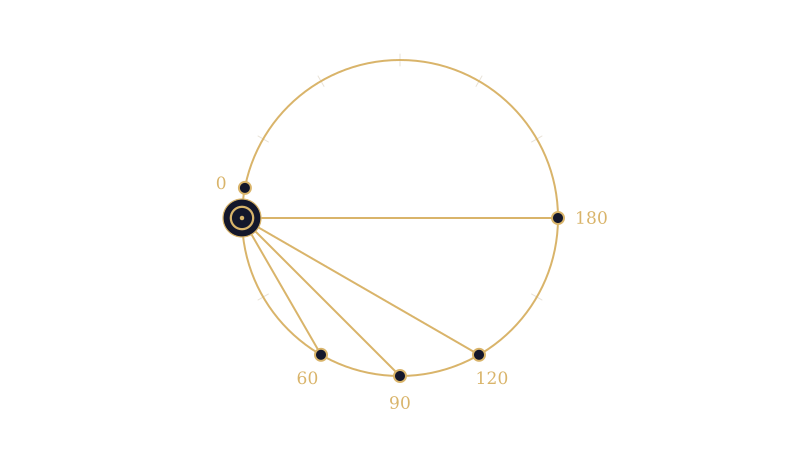
The column "Signs apart" explains why each angle has its tone. Signs four apart share an element, so a trine usually links two planets that run on the same thing, such as two fire signs. Signs three apart share a mode and never an element. A square links two planets that act in the same manner and want different things. The grid of elements and modes shows this for all twelve signs.
What an orb is
Planets are rarely at the exact angle. The orb is the allowed deviation: how far from exact an aspect may be and still count.
An example. Your Sun stands at 10 degrees Leo, your Moon at 14 degrees Scorpio. Leo and Scorpio are three signs apart, so the two are 94 degrees apart. That is a square with an orb of 4 degrees.
Three things are worth knowing:
- Commonly, astrologers allow up to about 6 to 8 degrees for major aspects, and less for sextiles.
- The smaller the orb, the more clearly an aspect is read. An aspect within one degree counts for more than one at seven.
- Astrologers differ on orbs. If two sources list different aspects for your chart, neither has made a mistake. They draw the line in different places.
See your own chart
Enter your birth date and get your Sun, Moon and Rising sign explained. Free, in about 60 seconds.
I was born on
See my free previewEasy and tense aspects: why a square is not bad
Trines and sextiles are called easy or flowing aspects. Squares and oppositions are called tense or dynamic. The conjunction depends on the two planets involved.
Older books simply called them good and bad. Many astrologers no longer read them that way, for a practical reason.
An easy aspect works without your attention. That is pleasant, and it also means you may take it for granted. Venus trine Jupiter is read as warmth and generosity that come naturally. Nobody has to practice it, and for that reason it can stay unused.
A tense aspect gets your attention. Two parts of you want different things, and you notice it. Mars square Saturn is read as drive meeting a brake: wanting to go and feeling held back. Over time, astrologers read exactly this as the making of endurance, because someone who has always had to push against resistance learns to keep going.
A trine is a talent you were handed. A square is one you build.
An opposition works in a similar way, with one difference: its two sides are often split between you and other people until you claim both. A chart full of trines is not a better chart. Most charts hold a mix: ease to rest on, friction to grow on.
How to read the aspects in your own chart
In a chart drawing, the aspects are the lines that cross the middle of the wheel. A full chart shows a lot of them, so do not start with all at once.
- Start with the Sun and the Moon. Which planets are in aspect with them?
- Pick the tightest aspects, the ones with the smallest orb.
- Name both planets in plain words, then add the tone of the angle. Moon trine Mercury: what you feel and how you speak cooperate, so feelings are easily put into words.
- Only then look at the rest.
A note on the birth time. Aspects between planets depend mainly on your date of birth. The Moon moves fast, so its aspects are less certain without a time. The Rising point, the degree of your Rising sign (also called the Ascendant), moves about one degree every four minutes. Aspects to it and to the Midheaven, the highest point of the chart, need an exact time.
The same five angles are used beyond your own chart. Between two people's charts they are the basis of synastry. Between the moving sky and your chart they are called transits.
What to do next
Get your chart, find the two or three tightest aspects, and read each as a sentence about two parts of you. Ask where you have seen that cooperation or that tug in your life. The step-by-step guide on how to read a birth chart shows where aspects fit in.
If you would rather have them read in context, a Birth Chart Reading is calculated from your exact birth data and written for your chart.
Questions, answered
What are the five major aspects in astrology?
The conjunction at 0 degrees, the sextile at 60, the square at 90, the trine at 120 and the opposition at 180 degrees. They are the angles between two planets, measured along the zodiac circle.
Is a square a bad aspect?
No. A square is read as friction between two needs that do not fit together by themselves. Astrologers see it as a source of drive and of skills built through effort.
What is an orb in astrology?
An orb is how far an aspect may deviate from the exact angle and still count. For major aspects it is commonly up to about 6 to 8 degrees, less for sextiles, and astrologers differ on the limits.
Do I need my birth time to know my aspects?
Not for most of them. Aspects between planets depend mainly on your date of birth. Aspects to the Moon are less certain without a time, and aspects to the Rising sign and Midheaven need an exact one.
Astrology is a tool for self-reflection, not a science, and it does not replace medical, psychological, legal or financial advice.
Keep reading
Birth chart basics
How to read a birth chart
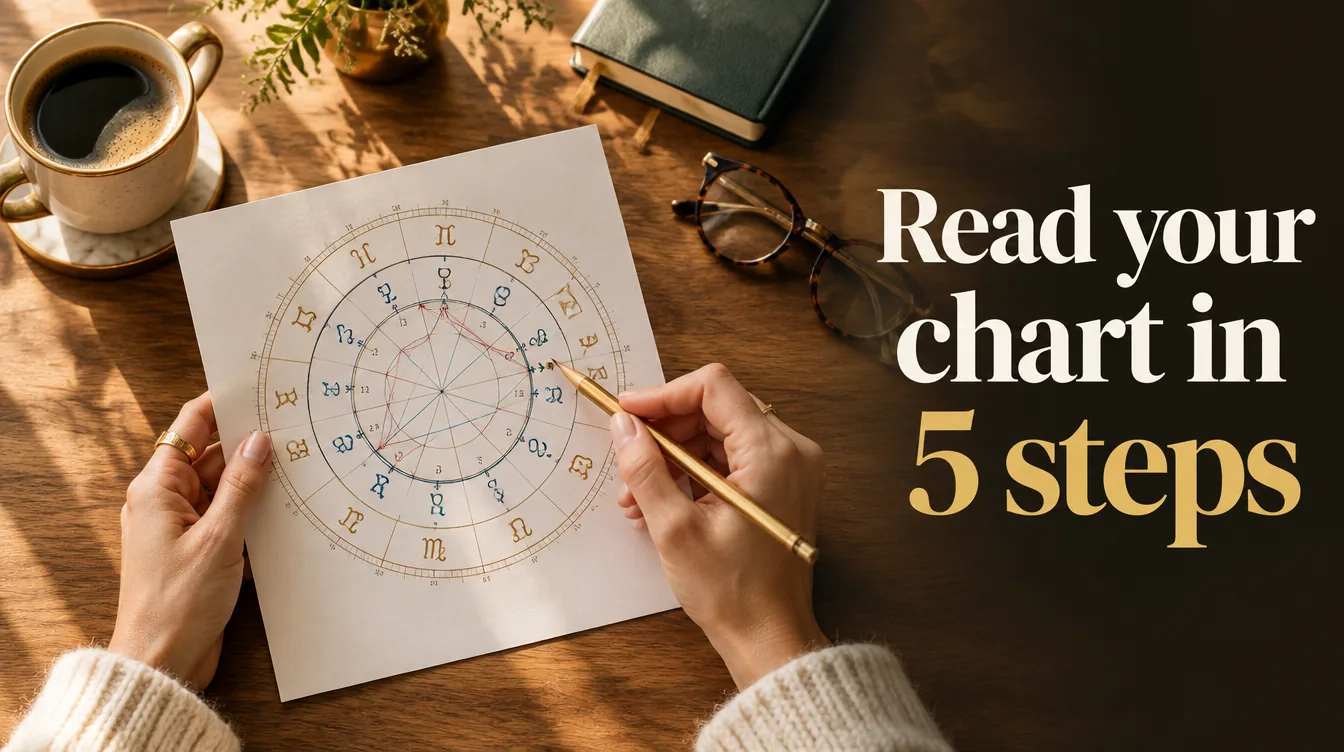
To read a birth chart, start with the Rising sign, then the Sun and Moon, the personal planets, the houses and the aspects. A step-by-step method for beginners.
6 min readRead more →
Love
Synastry aspects: how two charts talk to each other
A synastry aspect is an angle between your planet and your partner's. How to read one, which contacts astrologers check first, and what easy and tense mean.
6 min readRead more →
Birth chart basics
Cardinal, fixed and mutable signs: start, stay, adapt
Cardinal signs start, fixed signs sustain, mutable signs adapt. What the three modes of astrology mean and how they combine with the elements into twelve signs.
6 min readRead more →
Start with your free preview
I was born on
See my free previewFree preview in 60 seconds · One payment · No subscription
For self-reflection and entertainment. Not medical, psychological, legal or financial advice.