Birth chart basics
How to read a birth chart
Six steps that take you from a wheel full of symbols to a few clear sentences about yourself.
By the AstroScroll editorial team · Updated October 3, 2026 · 6 min read
In short
- Read a birth chart from the big pieces to the small ones: Rising sign first, then Sun and Moon, then Mercury, Venus and Mars, then the houses, then the aspects.
- Every placement is one sentence: the planet says what, the sign says how, the house says where in life.
- The last step matters most: look for themes that show up more than once.
- A chart describes tendencies. It does not predict events.
On this page
To read a birth chart, go from the big pieces to the small ones: start with the Rising sign on the left side of the wheel, then find the Sun and the Moon, then Mercury, Venus and Mars, then the houses where planets gather, and last the lines in the middle, called aspects. At the end, look for what repeats. A chart is read as a whole, not symbol by symbol.
What you see on a birth chart wheel
A birth chart, also called a natal chart, is drawn as a wheel with three layers. The outer ring shows the twelve signs of the zodiac. Inside it, the wheel is cut into twelve numbered sections, the houses. The planets sit around the ring as small symbols, called glyphs. The lines crossing the center are the aspects. What a birth chart is and what you need to calculate one
Most beginners get stuck on the glyphs. Here they are in words:
| Glyph looks like | Planet | Stands for |
|---|---|---|
| Circle with a dot in the center | Sun | Your core and your direction |
| Crescent | Moon | Your feelings and needs |
| Circle with a cross below and two horns on top | Mercury | How you think, learn and talk |
| Circle with a cross below | Venus | How you love and what you value |
| Circle with an arrow pointing up and to the right | Mars | Your drive and how you act |
| A shape like the number 4 | Jupiter | Where you grow and feel confident |
| A small h with a crossbar at the top | Saturn | Structure, limits, patience |
| Neptune is a trident; Uranus and Pluto vary by chart style | Uranus, Neptune, Pluto | Slow themes you share with your generation |
Many charts also come with a small list that names each planet with its sign and house. Use it. It is easier than counting sections on the wheel.
How to read a birth chart step by step
1. Find the Rising sign and the horizon line
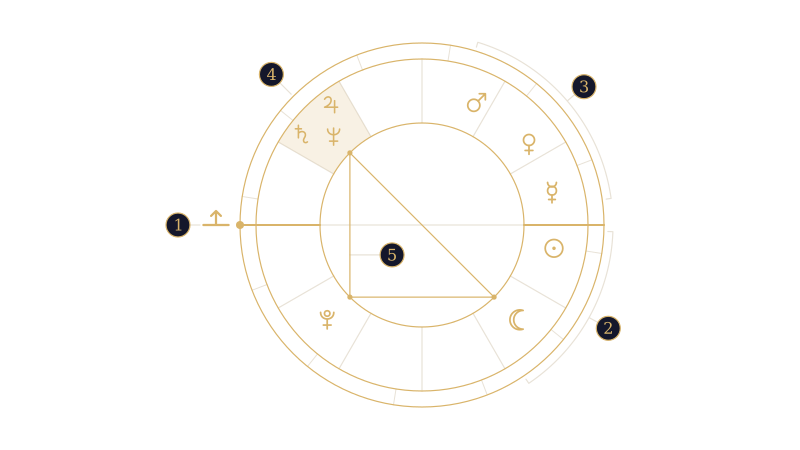
Look at the left side of the wheel, at the nine o'clock position. The sign there is your Rising sign, also called the Ascendant: the sign that was coming up in the east when you were born. From this point a line runs straight across the wheel. That is the horizon. Planets above it were in the sky at your birth, planets below it were out of sight.
This gives you a quick check. If you were born in daylight, the Sun belongs in the upper half. If it sits in the lower half, the birth time or the time zone was probably entered wrong. How to find your Rising sign
2. Read Sun, Moon and Rising sign
Find the Sun and the Moon and note the sign and the house of each. The Sun is read as your core, the Moon as your needs, the Rising sign as the way you meet the world. Write one sentence for each. What Sun, Moon and Rising sign mean together
3. Add Mercury, Venus and Mars
These are the personal planets: fast enough to differ from one person to the next. You will find Mercury and Venus near the Sun, because seen from Earth they never move far away from it.
Read each placement as one sentence. The planet says what, the sign says how, the house says where in life. Venus in Virgo in the sixth house: affection (what) that is shown in careful, practical ways (how) in daily work and routines (where).
4. See which houses are full
Each house stands for an area of life, such as home, partnership or career. Count where the planets gather. Three or more planets in one house point to an area that takes up a lot of your attention. Empty houses are normal. The twelve houses and what they mean
5. Look at the aspects
Aspects connect planets that stand at certain angles to each other. There are five main ones:
- Conjunction (0 degrees): two planets side by side. Their themes blend.
- Sextile (60 degrees) and trine (120 degrees): read as easy cooperation.
- Square (90 degrees) and opposition (180 degrees): read as friction that asks for work.
Do not try to read every line. Start with the aspects that touch the Sun or the Moon.
6. Put it together: look for what repeats
Now compare your notes. A Moon in Cancer, several planets in the fourth house and a Cancer Rising sign all point to home and belonging. Three signals, one theme.
A theme that appears once in a chart is a detail, and a theme that appears three times is a pattern.
Write down the two or three themes that keep coming back. Contradictions are not errors. A chart can show a need for closeness and a need for freedom in the same person.
See your own chart
Enter your birth date and get your Sun, Moon and Rising sign explained. Free, in about 60 seconds.
I was born on
See my free previewCommon beginner mistakes
- Reading one placement on its own. A single planet in a single sign is one voice among ten.
- Taking squares and oppositions as bad news. They describe tension, and tension is often where a person grows.
- Worrying about empty houses. There are ten planets and twelve houses, so every chart has some.
- Reading everything at once. Follow the order and stop when it stops making sense.
- Trusting a guessed birth time. The Rising sign and the houses depend on it.
- Reading the chart as a forecast. It describes tendencies, not events.
What a written reading does that the wheel does not
The wheel gives you positions. It does not tell you which of them carries the most weight, or what a careful Venus and an impatient Mars amount to in one person. Deciding that is the real work of reading a chart.
A written reading does that part for you. It puts the pieces together and says in plain language what the combination suggests. A Birth Chart Reading is calculated from your exact birth data and written for your chart, in twelve chapters.
Both ways have their place. Reading the wheel yourself teaches you the language. A written reading saves you the translation.
What to do next with your own chart
Take your chart and a sheet of paper and go through the six steps. Write one sentence per step, no more. If you get as far as step three on the first day, that is plenty. Come back to it a few days later and see which sentences still sound true.
Questions, answered
Where do I start when reading a birth chart?
Start on the left side of the wheel with the Rising sign and the horizon line. Then find the Sun and the Moon. These three give you the frame for everything else.
What do the lines in the middle of a birth chart mean?
They are aspects: connections between planets that stand at certain angles to each other, such as 90 or 120 degrees. They show which parts of you cooperate easily and which ones create friction.
Can I read my natal chart without a birth time?
Partly. You can read the planets in their signs and the aspects between them. The Rising sign and the houses need a birth time, so those steps have to wait.
How long does it take to learn to read a birth chart?
You can find your Sun, Moon and Rising sign in a few minutes. Putting a whole chart together takes practice, because the single pieces have to be weighed against each other.
Astrology is a tool for self-reflection, not a science, and it does not replace medical, psychological, legal or financial advice.
Keep reading
Birth chart basics
What is a birth chart?
A birth chart is a map of the sky at the exact minute and place you were born. What it shows, what you need to calculate one, and how to start reading yours.
6 min readRead more →
Planets & houses
The 12 houses in astrology, explained
The 12 houses in astrology are twelve areas of life, counted from your Rising sign. What each house means, what an empty house says, and why birth time matters.
6 min readRead more →
Sun, Moon & Rising
Sun, Moon and Rising: your Big Three
Your Big Three are your Sun, Moon and Rising sign. What each one means, how the three work together, and what you need to find yours.
6 min readRead more →
Start with your free preview
I was born on
See my free previewFree preview in 60 seconds · One payment · No subscription
For self-reflection and entertainment. Not medical, psychological, legal or financial advice.