Cardinal, fixed and mutable signs: start, stay, adapt
The three modes describe what a sign does with a beginning, a middle and an end, and together with the four elements they make each of the twelve signs one of a kind.
By the AstroScroll editorial team · Updated February 3, 2026 · 6 min read

In short
- Cardinal, fixed and mutable are the three modes of astrology, also called modalities or qualities.
- Cardinal signs (Aries, Cancer, Libra, Capricorn) start things, fixed signs (Taurus, Leo, Scorpio, Aquarius) sustain them, mutable signs (Gemini, Virgo, Sagittarius, Pisces) adapt and pass them on.
- The modes follow the seasons: every season opens with a cardinal sign, peaks in a fixed sign and ends in a mutable sign.
- Four elements times three modes give twelve combinations, and each sign has one of them to itself.
On this page
Cardinal, fixed and mutable are the three modes of astrology, also called modalities or qualities. They describe how a sign acts: cardinal signs start things, fixed signs keep them going, mutable signs adapt them and let them change. Each mode holds four signs, one from each element, and that combination is what makes each of the twelve signs distinct.
What cardinal, fixed and mutable mean
The four elements sort the signs by what they run on: action, substance, ideas or feeling. The modes sort them by what they do with it.
- Cardinal signs (Aries, Cancer, Libra, Capricorn) begin. They are read as initiating: they see what should happen next and make the first move. Their strength is getting things off the ground. Their growth edge is the long middle, when the excitement of starting has passed.
- Fixed signs (Taurus, Leo, Scorpio, Aquarius) hold. They are read as steady, loyal and thorough, the ones who stay with a task or a person and finish what was begun. Their growth edge is changing course, even when a change would help.
- Mutable signs (Gemini, Virgo, Sagittarius, Pisces) adapt. They are read as flexible, quick to adjust and good at transitions. Their growth edge is settling on one thing and staying with it.
No mode is better than another. Any project, family or team needs all three jobs done.
Why the modes follow the seasons
The modes are not an arbitrary sorting. They come from the calendar of the sky.
The zodiac used in Western astrology begins at the March equinox, the moment the Sun enters Aries, around March 20 or 21. From there, every season covers exactly three signs, and the modes mark its beginning, middle and end.
| Mode | Signs | Place in the season | What it does |
|---|---|---|---|
| Cardinal | Aries, Cancer, Libra, Capricorn | First sign | Opens the season |
| Fixed | Taurus, Leo, Scorpio, Aquarius | Middle sign | Holds it at full strength |
| Mutable | Gemini, Virgo, Sagittarius, Pisces | Last sign | Loosens it and leads into the next |
The four cardinal signs begin at the four turning points of the year. The Sun enters Aries at the March equinox, Cancer at the June solstice around June 21, Libra at the September equinox around September 23, and Capricorn at the December solstice around December 21 or 22. These dates are given in Universal Time and can shift by a day depending on where you live.
In the northern hemisphere this is spring, summer, fall and winter. South of the equator the seasons are reversed, but the pattern of beginning, middle and end is the same.
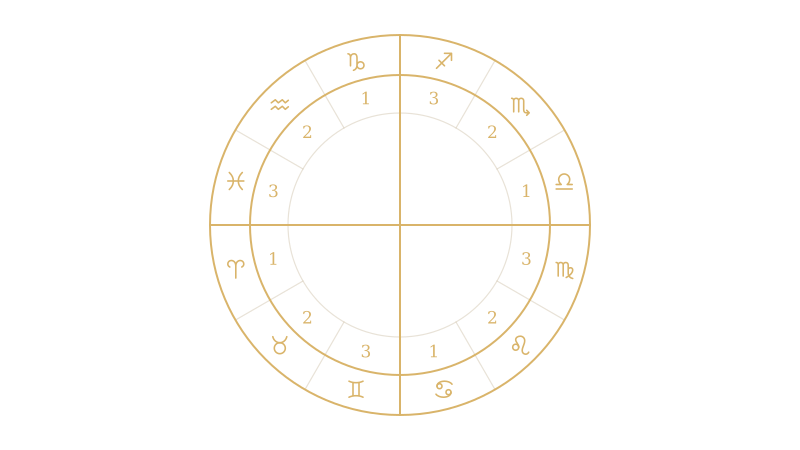
Every season needs someone to begin it, someone to keep it going and someone to let it change.
How modes and elements make twelve signs
Four elements times three modes give twelve combinations. Each one occurs exactly once, and each is a sign.
| Fire | Earth | Air | Water | |
|---|---|---|---|---|
| Cardinal | Aries | Capricorn | Libra | Cancer |
| Fixed | Leo | Taurus | Aquarius | Scorpio |
| Mutable | Sagittarius | Virgo | Gemini | Pisces |
This grid explains why signs of the same element can feel so different. Take the three fire signs.
- Aries is cardinal fire: the spark. It starts quickly and wants to go first.
- Leo is fixed fire: the hearth. It burns steadily, warms the people around it and stays loyal.
- Sagittarius is mutable fire: the fire that travels. It looks for the next horizon and changes direction easily.
It also works the other way. The four cardinal signs all start things, but each starts something else. Aries starts an action, Cancer a home or a circle of care, Libra a relationship or a conversation, Capricorn a long-term plan.
So a sign is not a random list of traits. It is one element in one mode. Once you know both, you can work out the core of any sign yourself.
See your own chart
Enter your birth date and get your Sun, Moon and Rising sign explained. Free, in about 60 seconds.
I was born on
See my free previewThe modes in your own chart
Your Sun sign gives you one mode. Your chart has more: the Moon, the Rising sign (also called the Ascendant) and the planets each stand in a sign with a mode of its own. To see your balance, note the signs of your Sun, Moon, Rising sign, Mercury, Venus and Mars, and count. Sun, Moon and Rising sign weigh the most.
How astrologers read the result:
- Mostly cardinal: many beginnings and a strong urge to act. The middle of a long project is where patience is tested.
- Mostly fixed: staying power and loyalty. Letting go of a plan, a habit or an opinion tends to take time.
- Mostly mutable: flexibility and range. Deciding, and staying decided, can be the harder part.
Little of a mode is not a flaw. It is read as a job you do deliberately instead of by reflex, or one you gladly share with other people.
The modes also explain where friction in a chart comes from. Signs of the same mode stand three or six signs apart, which is 90 or 180 degrees. Planets in those signs tend to form squares and oppositions, the angles astrologers read as tension. Two cardinal signs both want to lead, each in a different direction. More on this in the guide to aspects in astrology.
What to do with your modes
- Look up the mode of your Sun sign in the grid, then of your Moon and Rising sign. If you do not know them yet, start with Sun, Moon and Rising sign.
- Ask which job comes easiest to you: starting, keeping going or adapting. Then ask which one you tend to leave to others.
- Put mode and element together for each of your main signs, and read the result as one sentence: fixed water holds on to feeling, mutable air moves from idea to idea.
- Use the same two keys when you read a birth chart step by step.
If you would like the whole picture in one piece, a Birth Chart Reading is calculated from your exact birth data and written for your chart.
Questions, answered
Which signs are cardinal, fixed and mutable?
Cardinal: Aries, Cancer, Libra and Capricorn. Fixed: Taurus, Leo, Scorpio and Aquarius. Mutable: Gemini, Virgo, Sagittarius and Pisces.
What is the difference between a mode and an element?
The element describes what a sign runs on: action, substance, ideas or feeling. The mode describes what it does with that: start, sustain or adapt. Every sign has one of each.
Is one mode better than the others?
No. Starting, keeping going and adapting are three jobs that every project and every relationship needs. Each mode has a strength and a typical way of overdoing it.
How do I find the strongest mode in my chart?
Note the signs of your Sun, Moon, Rising sign, Mercury, Venus and Mars and count how many are cardinal, fixed and mutable. Sun, Moon and Rising sign weigh the most.
Astrology is a tool for self-reflection, not a science, and it does not replace medical, psychological, legal or financial advice.
Keep reading

Birth chart basics
The four elements in astrology: what you reach for first
The four elements of astrology sort the twelve signs into fire, earth, air and water. What each one is read as, and what a missing element in your chart means.
6 min readRead more →
Birth chart basics
Zodiac sign dates, and why there is no cusp sign
The dates of all twelve zodiac signs, why they shift by a day from year to year, and what being born on the cusp really means: the Sun is in one sign only.
6 min readRead more →
Birth chart basics
Aspects in astrology: how your planets talk to each other
Aspects are the angles between planets in a chart. What conjunction, sextile, square, trine and opposition mean, what an orb is, and why a square is not bad.
6 min readRead more →
Start with your free preview
I was born on
See my free previewFree preview in 60 seconds · One payment · No subscription
For self-reflection and entertainment. Not medical, psychological, legal or financial advice.