Synastry aspects: how two charts talk to each other
Two planets name a topic, the angle between them sets the tone. How to read a single contact between two charts, and why none of them is a verdict.
By the AstroScroll editorial team · Updated February 17, 2026 · 6 min read

In short
- A synastry aspect is an angle between a planet in one person's birth chart and a planet in another person's chart.
- The two planets name the topic, the angle sets the tone, and the closeness of the angle decides how much weight the contact gets.
- Astrologers read contacts between Sun, Moon, Venus, Mars and Saturn first, because these describe identity, needs, affection, desire and commitment.
- Easy and tense contacts both belong to every comparison, and no aspect says whether a relationship works.
On this page
A synastry aspect is an angle between a planet in your birth chart and a planet in another person's chart. Astrologers read it as a topic the two of you share: the two planets name the topic, and the angle describes whether it tends to flow or to cause friction. The contacts read first involve the Sun, the Moon, Venus, Mars and Saturn, and none of them says whether a relationship works.
What a synastry aspect is
Synastry is the comparison of two birth charts, planet by planet. Both charts are placed on the same zodiac, the circle of twelve signs with its 360 degrees. Then the distance between each planet of one person and each planet of the other is measured. When that distance is close to one of five angles, it counts as an aspect. How two birth charts are compared
| Aspect | Angle | Read as |
|---|---|---|
| Conjunction | 0° | Two planets in the same place. Their topics merge. |
| Sextile | 60° | An easy contact that works when you use it. |
| Square | 90° | A tense contact: two ways of doing things meet at a right angle. |
| Trine | 120° | The easiest contact. Things flow without effort. |
| Opposition | 180° | A pull between two sides. Each has what the other lacks. |
A chart holds the Sun, the Moon and eight planets, so two charts give 100 possible pairs. Most pairs form no aspect at all, and a handful of close ones carry most of the meaning.
The five major aspects work the same way inside a single chart. In synastry each planet belongs to a different person, so an aspect describes an exchange, not a trait.
How to read a single synastry aspect
Ask three questions, in this order.
- Which two planets? They name the topic. Your Moon and your partner's Saturn: your need for comfort meets their sense of duty.
- Which angle? It sets the tone. A trine between those two tends to feel like steady support. A square can feel like being corrected when you wanted comfort.
- How close? The gap between the real distance and the exact angle is called the orb. The smaller the orb, the more weight the aspect gets. Many astrologers allow up to around 6 to 8 degrees for the major aspects and less for the sextile, and they differ on this.
An example. One of you has Venus at 12° Taurus, the other has Mars at 15° Virgo. The two points are 123 degrees apart, 3 degrees past an exact trine. That counts as a close one.
Signs alone give only a first hint. Venus at 2° Taurus and Mars at 27° Virgo stand in the same two signs, but 145 degrees apart: no trine. This is why a comparison needs degrees.
The contacts astrologers read first
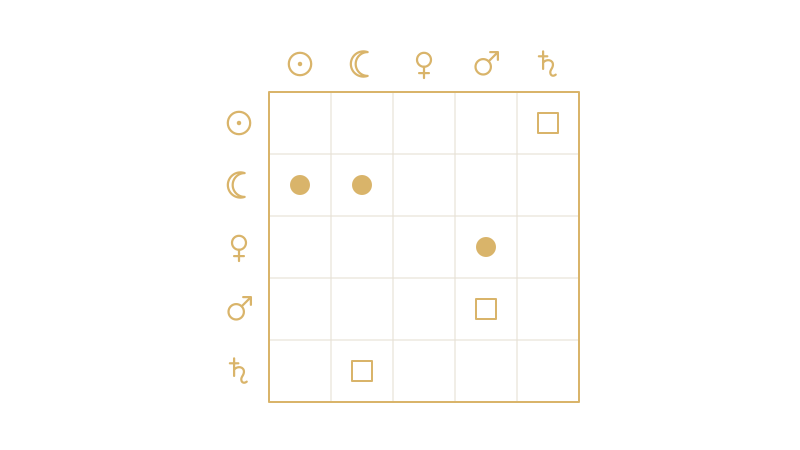
Five bodies come first. Each brings one thing into a contact.
| Planet | What it brings into a contact |
|---|---|
| Sun | Who you are and what you are proud of. Contacts to it are about feeling seen. |
| Moon | What you need to feel safe. Contacts to it are about feeling cared for. |
| Venus | What you enjoy and how you show affection. Contacts to it are about feeling liked. |
| Mars | Desire, drive and temper. Contacts to it are about spark and about how you argue. |
| Saturn | Commitment, limits and time. Contacts to it are about what holds and what weighs. |
Combine any two rows and you have the topic of a contact. One person's Sun on the other's Moon: who I am meets what you need. Venus and Mars together describe attraction.
See your own chart
Enter your birth date and get your Sun, Moon and Rising sign explained. Free, in about 60 seconds.
I was born on
See my free previewEasy and tense contacts side by side
The same pair of planets reads differently depending on the angle.
| Contact | As a trine or sextile | As a square or opposition |
|---|---|---|
| Moon and Moon | You calm down in similar ways and rarely have to explain a mood. | One needs talk, the other quiet. Comfort has to be asked for in words. |
| Venus and Mars | What one enjoys, the other offers without being asked. | A strong pull with different timing: one moves fast, the other wants to be courted. |
| Sun and Saturn | One takes the other's plans seriously and steadies them. | Support can come across as criticism, and one of you may feel judged. |
The conjunction is neither easy nor tense by itself. Venus on Venus is read as shared taste, Mars on Saturn as drive meeting a brake.
Tense does not mean bad. A comparison made only of trines can describe a comfortable bond in which little ever moves.
Two planets name the topic, the angle sets the tone, and what you do with it is up to the two of you.
Direction, repetition and the slow planets
Three things a plain list of aspects hides.
- Direction. Your Saturn on their Moon is not the same contact as their Saturn on your Moon. In the first, you are the one who brings structure, and they are the one who feels it.
- Repetition. One aspect is a single note. When three contacts say something similar, astrologers treat it as a theme. Contradictions are normal: easy Moon contacts next to tense Mars contacts describe two people who rest well together and compete over decisions.
- Slow planets. Uranus, Neptune and Pluto stay in one sign for many years. If you are close in age, your slow planets stand near each other, as they do for everyone born around the same time. Astrologers do not read those contacts personally.
What to do next with two charts
- Ask for the other person's birth data instead of guessing. The Moon passes through a sign in about two and a half days, so its exact degree needs the birth time.
- Write down the positions of Sun, Moon, Venus, Mars and Saturn for each of you, with degrees.
- Find the three closest contacts and ask the three questions: which planets, which angle, how close.
- Read them to each other and ask whether this sounds like the two of you. Where it does not, trust what you know.
No aspect guarantees a relationship and none rules one out. A Compatibility Reading compares your chart with your partner's, calculated from both sets of exact birth data. It describes tendencies and gives no verdict and no score. To see the two charts as one, read on about the composite chart.
Questions, answered
What is a synastry aspect?
It is an angle between a planet in your birth chart and a planet in another person's chart. Astrologers read it as a topic the two of you share and as a hint at whether that topic tends to flow or to cause friction.
Which synastry aspects matter most?
Close contacts between Sun, Moon, Venus, Mars and Saturn are read first. The closer an aspect is to its exact angle, the more weight it gets, so three close contacts say more than twenty loose ones.
Is a square in synastry a bad sign?
No. A square marks a topic where two people work differently and have to find an arrangement. Astrologers read it as friction and energy, not as a warning.
Is there an aspect that shows a soulmate?
No. Astrology has no aspect that proves two people belong together. Close contacts describe where a connection feels strong, and the two people decide what they make of it.
Astrology is a tool for self-reflection, not a science, and it does not replace medical, psychological, legal or financial advice.
Keep reading
Love
Birth chart compatibility: what two charts show
Birth chart compatibility compares two whole charts, not two Sun signs. What synastry is, which comparisons matter most, and what a comparison cannot tell you.
6 min readRead more →
Love
Composite chart meaning: one chart for two people
A composite chart is one chart made from the midpoints of two birth charts. How it is calculated, how it differs from synastry and what it is read as.
6 min readRead more →
Birth chart basics
Aspects in astrology: how your planets talk to each other
Aspects are the angles between planets in a chart. What conjunction, sextile, square, trine and opposition mean, what an orb is, and why a square is not bad.
6 min readRead more →
Start with your free preview
I was born on
See my free previewFree preview in 60 seconds · One payment · No subscription
For self-reflection and entertainment. Not medical, psychological, legal or financial advice.