
Composite chart meaning: one chart for two people
Take the point halfway between your Sun and your partner's, do the same for every planet, and you get a chart that belongs to neither of you: the chart of the relationship.
By the AstroScroll editorial team · Updated August 28, 2026 · 6 min read

In short
- A composite chart is a single chart made from two birth charts: each of its planets sits at the midpoint between your planet and your partner's.
- Astrologers read it as a picture of the relationship itself, while synastry compares the two charts and shows how each person affects the other.
- It is a calculated chart, not a sky that ever existed, and its Rising sign and houses need both birth times.
- A composite chart describes the character of a bond as a tendency. It does not say whether the relationship works or lasts.
On this page
A composite chart is a single chart made from two birth charts. For every planet it takes the point halfway between your position and your partner's, the midpoint. Astrologers read the result as a picture of the relationship itself: what the two of you are like together, as distinct from what each of you is like alone. It describes tendencies and gives no verdict.
How a composite chart is calculated
Start with the two Suns. Each stands at a certain degree of the zodiac, the circle of twelve signs with 360 degrees. Find the point halfway between them, going the shorter way around the circle. That point is the composite Sun. Then do the same for the two Moons, the two Venuses, and so on through every planet.
An example. One of you has the Sun at 10° Aries, the other at 10° Leo. The two points are 120 degrees apart, so the midpoint lies 60 degrees from each: at 10° Gemini. Neither of you is a Gemini. The relationship has a Gemini Sun.
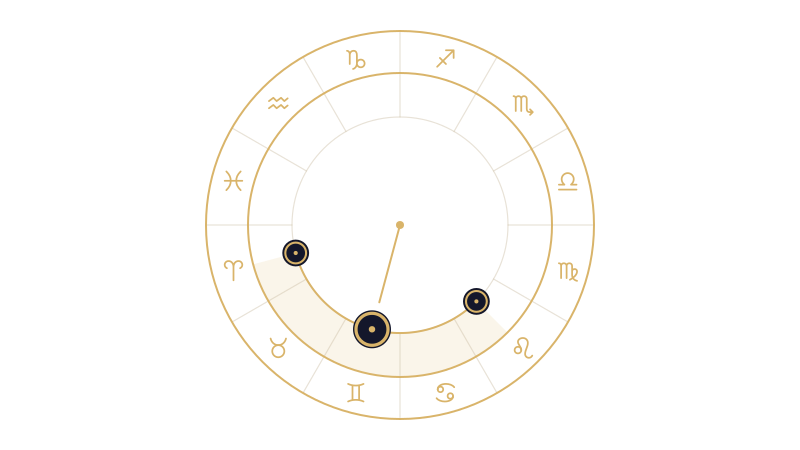
Three things follow from this method.
- It is not a sky that ever existed. A birth chart shows a real moment. A composite chart is arithmetic. In a birth chart Venus is never more than about 47 degrees from the Sun. In a composite chart the two can end up far apart, even opposite each other.
- The planets need two dates of birth. The Moon changes signs about every two and a half days, so its midpoint is only exact with both birth times.
- The Rising sign and the houses need both birth times. The Rising sign (also called the Ascendant) is the sign on the eastern horizon at birth, and the houses are the twelve sections of a chart linked to areas of life. Astrologers use more than one method to derive them for a composite.
Some astrologers work with a different technique: a chart for the moment and the place halfway between the two births. That is a separate chart with its own positions. Everything below refers to the midpoint chart.
Composite chart and synastry: the difference
Synastry is the other way to look at two charts: both stay as they are and are compared planet by planet. How synastry aspects are read
| Synastry | Composite chart | |
|---|---|---|
| Number of charts | Two, kept apart and compared | One, made from both |
| The question | How do we affect each other? | What are we like together? |
| What it shows | Who brings what, and where each of you is touched | The character of the relationship as a unit |
| A typical sentence | Your Saturn steadies my Moon. | This relationship takes itself seriously. |
The two answer different questions, so one does not replace the other. Astrologers usually read synastry first and the composite second.
Synastry asks what two people do to each other. The composite chart asks what they are together.
What the composite chart is read as
A composite chart is read much like a birth chart, with one change: every statement is about the pair.
| In the composite | Read as |
|---|---|
| Sun | What the relationship is about and where it comes alive. |
| Moon | How it feels from the inside, and what the two of you need to be at ease together. |
| Mercury | How you talk as a pair: pace, humor, the subjects you return to. |
| Venus | How affection is shown between you and what you enjoy together. |
| Mars | How you act, decide and argue as a team. |
| Saturn | What you commit to, and where the bond asks for patience. |
| Houses | The area of life where the relationship mostly takes place. |
The surprising part is that a composite planet often stands in a sign neither of you has. Take a Moon at 15° Scorpio and a Moon at 15° Pisces, two water Moons, both read as feeling deeply. Their midpoint is 15° Capricorn, an earth sign. Astrologers would read this as two sensitive people whose relationship feels safest when it is reliable: plans that hold, promises that are kept.
The angles between composite planets are read as well. Angles of 60 and 120 degrees are read as easy, angles of 90 and 180 degrees as tense, just as in a single chart. With both birth times the houses add where the relationship lives. A composite Sun in the fourth house, the house of home and roots, points to a bond that is mostly lived at home. In the tenth house, the house of career and public role, it points to one that is visible to others or built around shared work. What the twelve houses mean
See your own chart
Enter your birth date and get your Sun, Moon and Rising sign explained. Free, in about 60 seconds.
I was born on
See my free previewWhat a composite chart is not
- Not a verdict. There is no good or bad composite chart. Each one describes a character, with easy sides and demanding ones.
- Not a replacement for two people. Each of you keeps your own chart, your own needs and your own choices. The relationship has a character. It does not have a will of its own.
- Not a forecast. A composite chart does not show how long a relationship lasts or how it ends. It describes how a bond tends to feel, and people decide what they do with that.
- Not only for couples. The same method is used for friends, siblings or working partners.
What to do next with your composite chart
- Read your own chart first. A composite makes more sense once you know what each of you brings.
- Compare the two charts in synastry. That shows the exchange between you.
- Then look at the composite Sun, Moon and Venus. Ask one question: does this sound like the two of us at our best?
- Where it does, you have words for something you already knew. Where it does not, trust your experience over the chart.
A Compatibility Reading compares your birth chart with your partner's, calculated from both sets of exact birth data. It describes tendencies and never gives a score or a verdict.
Questions, answered
What is a composite chart?
It is one chart made from two birth charts. For every planet, the point halfway between the two people's positions is taken. Astrologers read the result as a picture of the relationship itself.
What is the difference between synastry and a composite chart?
Synastry keeps both charts and compares them planet by planet, so it shows how two people affect each other. The composite merges them into one chart and describes what the two are like as a unit.
Do we need both birth times for a composite chart?
The composite planets and their signs can be calculated from two dates of birth, although the Moon may be uncertain. The composite Rising sign and the houses need both exact birth times.
Can a composite chart show whether a relationship will last?
No. It describes how a relationship tends to feel and what it revolves around. Whether it lasts depends on what both people do, and no chart decides that.
Astrology is a tool for self-reflection, not a science, and it does not replace medical, psychological, legal or financial advice.
Keep reading

Love
Synastry aspects: how two charts talk to each other
A synastry aspect is an angle between your planet and your partner's. How to read one, which contacts astrologers check first, and what easy and tense mean.
6 min readRead more →
Love
Birth chart compatibility: what two charts show
Birth chart compatibility compares two whole charts, not two Sun signs. What synastry is, which comparisons matter most, and what a comparison cannot tell you.
6 min readRead more →
Love
Venus and Mars in love: what you enjoy and how you go after it
Venus describes what you enjoy and are drawn to, Mars how you go after it. How the two work together in your own chart and between two people's charts.
6 min readRead more →
Start with your free preview
I was born on
See my free previewFree preview in 60 seconds · One payment · No subscription
For self-reflection and entertainment. Not medical, psychological, legal or financial advice.