The Moon phase you were born under
Eight phases, one angle: what the distance between the Sun and the Moon at your birth is read as, and how to find it.
By the AstroScroll editorial team · Updated March 12, 2026 · 6 min read
In short
- Your birth Moon phase is the angle between the Sun and the Moon at the moment you were born, counted from the Sun forward to the Moon.
- Astrology divides the Moon's cycle into eight phases of 45 degrees each, from the New Moon to the waning crescent.
- A waxing phase is read as building and reaching outward, a waning phase as sharing, sorting and completing.
- The phase is separate from your Moon sign: the sign describes what you need, the phase how your needs and your aims work together.
On this page
The Moon phase you were born under is the angle between the Sun and the Moon at the moment of your birth. Astrology divides the Moon's cycle into eight phases of 45 degrees each, from the New Moon through the Full Moon to the last thin crescent. The phase is read as the way your aims, shown by the Sun, and your needs, shown by the Moon, work together.
What the Moon phase at birth is
The Moon has no light of its own. One half of it is always lit by the Sun. How much of that lit half you see from Earth depends on where the Moon stands in relation to the Sun.
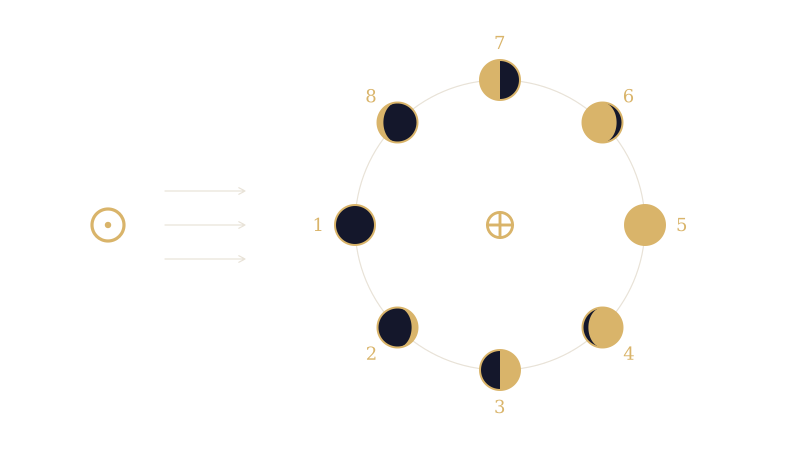
When the Moon stands between Earth and the Sun, its lit side faces away from you: New Moon. When it stands opposite the Sun, you see the whole lit side: Full Moon. From one New Moon to the next takes about 29.5 days.
A phase is therefore an angle, measured along the zodiac from the Sun forward to the Moon. At New Moon the angle is zero. At first quarter the Moon is 90 degrees ahead of the Sun. At Full Moon it is 180 degrees ahead, exactly opposite.
One detail confuses many people: at first quarter you see a half Moon. The name counts the cycle, not the disc.
Waxing or waning: the first thing to read
Before the eight phases, look at the two halves.
- Waxing Moon. The Moon is less than 180 degrees ahead of the Sun and its light is growing. You see it in the evening sky. Astrologers read a waxing birth Moon as building: you tend to act first and understand later, and you learn by doing.
- Waning Moon. The Moon is past the Full Moon and its light is shrinking. You see it late at night and in the morning sky. A waning birth Moon is read as distributing: you tend to understand first, draw conclusions from experience and pass things on.
Neither half makes a person more active or more thoughtful. They describe where the weight tends to lie.
The eight Moon phases and what each is read as
| No. | Phase | Moon ahead of the Sun | What it is read as |
|---|---|---|---|
| 1 | New Moon | 0° to 45° | Beginning. You act on instinct, start things readily and often understand your motives only afterward. |
| 2 | Waxing crescent | 45° to 90° | Pushing through. You have something new to establish and work against the pull of old habits. |
| 3 | First quarter | 90° to 135° | Deciding. You grow through friction, like to act and build, and get restless when nothing moves. |
| 4 | Waxing gibbous | 135° to 180° | Refining. You ask how it could be better, analyze, improve and want to get it right. |
| 5 | Full Moon | 180° to 225° | Seeing. You are strongly aware of two sides and tend to understand yourself through relationships. |
| 6 | Waning gibbous, also called disseminating | 225° to 270° | Sharing. You want to pass on what you have understood, by teaching, telling or showing. |
| 7 | Last quarter | 270° to 315° | Re-evaluating. You question what no longer fits and change course from the inside, often before others notice. |
| 8 | Waning crescent, also called balsamic | 315° to 360° | Completing. You finish, let go and reflect, and often sense what comes next before it has a shape. |
Read these as tendencies, not as types. No phase is better than another, and the rest of your chart decides how strongly yours shows.
See your own chart
Enter your birth date and get your Sun, Moon and Rising sign explained. Free, in about 60 seconds.
I was born on
See my free previewHow to find the Moon phase you were born under
- Get both positions. You need the sign and degree of your Sun and of your Moon. A calculated birth chart shows them.
- Count forward from the Sun. Go through the zodiac in its usual order, Aries, Taurus, Gemini and so on, until you reach the Moon. Every full sign counts 30 degrees.
- Look up the result in the table above.
An example: your Sun is at 10 degrees Leo, your Moon at 25 degrees Scorpio. From 10 degrees Leo to 10 degrees Scorpio is three signs, so 90 degrees. Add the remaining 15 degrees and you get 105 degrees. You were born in the first quarter phase.
If you only know the two signs, you get a rough idea. Sun and Moon in the same sign means you were born around the New Moon, just after it or, in the balsamic phase, just before it. Sun and Moon in opposite signs means around the Full Moon.
Each phase lasts three to four days. On most days your date of birth is enough, and the birth time matters only close to the change from one phase to the next.
Moon phase and Moon sign answer different questions
Your Moon sign is the sign the Moon stood in. It describes what you need to feel safe. The phase says nothing about that. It describes the relationship between the two lights of your chart.
Your Moon sign says what you need. Your Moon phase says how those needs get along with what you are aiming for.
The main turning points of the cycle are aspects, the angles astrologers read between two points in a chart. The New Moon is a conjunction, the two quarters are squares, the Full Moon is an opposition.
- Born close to the New Moon, your Sun and Moon usually share a sign. Aim and need speak the same language, which is read as single-minded.
- Born at a quarter Moon, Sun and Moon stand at a right angle. What you want and what you need pull in different directions, and that friction tends to make you act.
- Born close to the Full Moon, your Sun and Moon usually stand in opposite signs. With the Sun in Aries and the Moon in Libra, you want to go ahead on your own and need company and agreement. Both are yours.
The guide to Sun, Moon and Rising adds the third part: the Rising sign, also called the Ascendant.
What to do next
- Find your phase and read its line in the table. Ask where you recognize it.
- Read it together with your Sun sign and your Moon sign. The phase is the link between them.
- Watch the sky. About every 29.5 days the Moon returns to the phase you were born under. Notice how those days feel. The guide to the New Moon and Full Moon explains the monthly rhythm.
A Birth Chart Reading is written for your chart and calculated from your exact birth data.
Questions, answered
How do I find the Moon phase I was born under?
You need the positions of the Sun and the Moon at your birth. Count the degrees from the Sun forward through the zodiac to the Moon and look up the result: 0 to 45 degrees is the New Moon phase, 180 to 225 degrees the Full Moon phase.
Do I need my birth time for my Moon phase?
Usually not. Each phase lasts three to four days, so on most days the date of birth is enough. The time matters only if you were born close to the change from one phase to the next.
What does it mean to be born on a Full Moon?
The Sun and the Moon stood on opposite sides of the sky. Astrologers read this as a strong awareness of two sides and a tendency to understand yourself through other people. It is one of eight phases, not a better or worse one.
Is the Moon phase the same as the Moon sign?
No. The Moon sign is the zodiac sign the Moon stood in. The Moon phase is the angle between the Moon and the Sun. Two people with the same Moon sign can be born under different phases.
Astrology is a tool for self-reflection, not a science, and it does not replace medical, psychological, legal or financial advice.
Keep reading

Sun, Moon & Rising
What is my Moon sign?
Your Moon sign is the zodiac sign the Moon was in when you were born. It describes your feelings and needs. What it means, and what you need to find yours.
6 min readRead more →
The year ahead
New Moon and Full Moon: what each one means
At New Moon the Moon stands with the Sun, at Full Moon opposite it. What astrologers read into each, and how to use the rhythm for reflection with your chart.
6 min readRead more →
Sun, Moon & Rising
Sun, Moon and Rising: your Big Three
Your Big Three are your Sun, Moon and Rising sign. What each one means, how the three work together, and what you need to find yours.
6 min readRead more →
Start with your free preview
I was born on
See my free previewFree preview in 60 seconds · One payment · No subscription
For self-reflection and entertainment. Not medical, psychological, legal or financial advice.