New Moon and Full Moon: what each one means
About every 29.5 days the Moon goes from dark to full and back. How the two turning points come about, and what astrologers read into them.
By the AstroScroll editorial team · Updated August 10, 2026 · 6 min read
In short
- At New Moon the Moon stands in the same place in the zodiac as the Sun, and at Full Moon it stands exactly opposite the Sun.
- From one New Moon to the next it takes about 29.5 days, and the Full Moon falls about two weeks after the New Moon.
- Astrologers read the New Moon as a time to begin something and the Full Moon as a time when things become visible and can be reviewed.
- The sign of a New or Full Moon is the same for everyone, while the house it falls in depends on your own birth chart.
On this page
A New Moon is the moment when the Moon stands in the same place in the zodiac as the Sun, and a Full Moon is the moment when it stands exactly opposite the Sun. Astrologers read the New Moon as a time to begin something and the Full Moon, about two weeks later, as a time when things become visible and can be reviewed. The whole cycle takes about 29.5 days.
The astronomy: what happens at New Moon and Full Moon
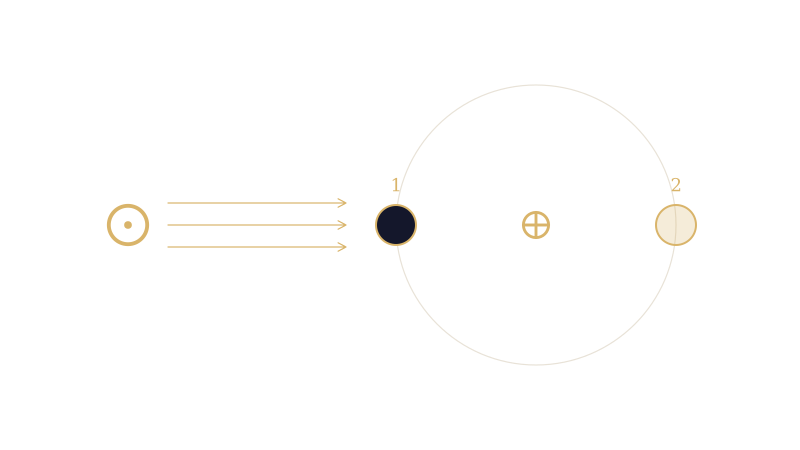
The Moon circles the Earth, and the Sun always lights one half of it. How much of that lit half you see depends on the angle between the Sun and the Moon.
- New Moon. The Moon stands in the same direction as the Sun. Its lit side faces away from the Earth, and it is up during the day, lost in the sunlight. You cannot see it.
- Full Moon. The Moon stands opposite the Sun. You see the whole lit side, and the Moon rises around sunset.
Two numbers explain the rhythm. The Moon needs about 27.3 days to go once around the zodiac. From one New Moon to the next, however, it takes about 29.5 days. The reason is that the Sun moves too, about one degree per day. After 27.3 days it is almost one sign further on, and the Moon needs about two more days to catch up.
Three things follow from this:
- A New Moon is always in the sign the Sun is in at that time.
- A Full Moon is always in the sign opposite the Sun.
- Each New Moon falls further along the zodiac than the last, usually in the next sign.
When a New or Full Moon happens close to the Moon's nodes, the two points where the Moon's orbit crosses the path of the Sun, it becomes an eclipse: a solar eclipse at New Moon, a lunar eclipse at Full Moon. The New Moon of August 12, 2026 is a total solar eclipse in Leo, the Full Moon of August 28, 2026 a partial lunar eclipse in Pisces. The eclipses of 2027
What the New Moon and the Full Moon are read as
| New Moon | Full Moon | |
|---|---|---|
| In the sky | Sun and Moon in the same sign | Sun and Moon in opposite signs |
| Light | The Moon is not visible | The whole disc is lit |
| Read as | Beginning, sowing, setting a direction | High point, seeing clearly, reviewing, letting go |
| A question to ask | What do I want to start? | What has become visible, and what can I finish? |
The reading follows the light. In the dark of the New Moon nothing is on show yet, so it is read as a quiet start. At Full Moon everything is lit, so it is read as the point where results and feelings come into view.
There is a second layer. In a birth chart the Sun stands for what you want and who you are, the Moon for what you feel and need. At New Moon the two stand together. At Full Moon they face each other from opposite signs, which astrologers read as two sides of life asking to be balanced.
Astrology does not treat either as a force that acts on you. Both are read as symbols, and as moments that are good for checking in with yourself.
New Moon and Full Moon in the same sign, six months apart
A New Moon falls in a sign while the Sun is in that sign. The Full Moon in the same sign comes about six months later, when the Sun has reached the opposite sign.
Astrologers read these two as a pair. What you began at the New Moon in a sign is looked at in full light at the Full Moon in that sign, half a year on.
An example from 2027: the New Moon of February 6, 2027 falls at 18° Aquarius. The Full Moon of August 17, 2027 falls at 24° Aquarius. Both happen to be eclipses. The dates are given in Universal Time and can shift by one day depending on where you live.
The New Moon asks what you want to begin. The Full Moon in the same sign, six months later, shows what has become of it.
See your own chart
Enter your birth date and get your Sun, Moon and Rising sign explained. Free, in about 60 seconds.
I was born on
See my free previewWhich house a New Moon or Full Moon falls in for you
The sign of a New or Full Moon is the same for everyone. What is personal is the house. Houses are the twelve sections of a birth chart, each linked to an area of life. They depend on your birth time and place, so the same New Moon falls in the fourth house for one person and in the tenth for another. What the twelve houses mean
A New Moon marks one house. A Full Moon always marks two that lie opposite each other: the Moon in one, the Sun in the other.
| Houses | A Full Moon here is read as a balance between |
|---|---|
| 1 and 7 | Yourself and partnership |
| 2 and 8 | What is yours and what is shared |
| 3 and 9 | Everyday learning and the bigger picture: travel, study, beliefs |
| 4 and 10 | Home and career |
| 5 and 11 | Play and romance, friends and groups |
| 6 and 12 | Daily work and rest |
Two more things make it personal. A New or Full Moon within a few degrees of a planet in your chart is read as speaking to that planet. And your own Moon sign and the Moon phase you were born under describe how you deal with feelings in general.
How to use the rhythm for reflection
- At New Moon, write down one thing you want to begin or one question you want to follow. Keep it small.
- At Full Moon, two weeks later, read it again. What has become visible? What can you finish or let go of?
- Note the sign and your house. After a few months you see which areas of life keep coming up.
- Look back after six months, at the Full Moon in the sign of your New Moon note.
This is a rhythm for checking in, about twice a month. It is not a schedule for decisions, and nothing is lost if you skip one.
To know your houses you need a calculated chart. A Birth Chart Reading is calculated from your exact birth data and written for your chart.
Questions, answered
What is the difference between a New Moon and a Full Moon?
At New Moon the Moon stands in the same direction as the Sun and cannot be seen. At Full Moon it stands opposite the Sun and its whole disc is lit. Astrologers read the first as a beginning and the second as a high point and a review.
How often is there a New Moon or a Full Moon?
From one New Moon to the next it takes about 29.5 days, and the same is true for Full Moons. The Full Moon comes about two weeks after the New Moon.
Which zodiac sign is a New Moon or Full Moon in?
A New Moon is always in the sign the Sun is in at that time. A Full Moon is always in the opposite sign.
Does the Full Moon change how I feel?
Astrology does not treat the Full Moon as a force acting on you. It reads it as a symbol for things becoming visible, and as a good moment to look at what has grown since the New Moon.
Astrology is a tool for self-reflection, not a science, and it does not replace medical, psychological, legal or financial advice.
Keep reading
Sun, Moon & Rising
The Moon phase you were born under
The Moon phase you were born under is the angle between the Sun and the Moon at your birth. What each of the eight phases is read as, and how to find yours.
6 min readRead more →
Sun, Moon & Rising
What is my Moon sign?
Your Moon sign is the zodiac sign the Moon was in when you were born. It describes your feelings and needs. What it means, and what you need to find yours.
6 min readRead more →
The year ahead
Eclipses 2027: five dates and how astrologers read them
There are five eclipses in 2027, among them the long total solar eclipse of August 2. All dates and signs, how astrologers read them, and your own chart.
6 min readRead more →
Start with your free preview
I was born on
See my free previewFree preview in 60 seconds · One payment · No subscription
For self-reflection and entertainment. Not medical, psychological, legal or financial advice.