Dominant planet: what sets the tone of your chart
One or two planets usually carry more weight than the rest of a chart, and astrologers find them by weighing several clues, not with one formula.
By the AstroScroll editorial team · Updated September 11, 2026 · 6 min read

In short
- Your dominant planet is the planet that carries the most weight in your birth chart.
- Astrologers find it by weighing clues: a planet on one of the four angles, the ruler of the Rising sign, a planet with many aspects or in its own sign.
- There is no single official formula, so different sources can name different planets for the same chart.
- It is read as a tone that runs through the whole chart, not as a replacement for your Sun, Moon and Rising sign.
On this page
Your dominant planet is the planet that carries the most weight in your birth chart. Astrologers find it by weighing several clues: a planet close to one of the four angles of the chart, the planet that rules your Rising sign, a planet with many aspects. There is no single official formula, so two sources can name different planets for the same chart.
What a dominant planet is
In a birth chart, each of the ten planets stands for a part of you: the Moon for feelings, Mercury for thinking, Mars for drive, and so on. Astrology counts the Sun and the Moon as planets. All ten are in every chart, but they are not equally prominent. One planet may stand in a very visible place and be connected to half the chart, while another sits quietly on its own.
The dominant planet is the one whose themes run through the whole chart. It is not the same as your Sun sign, the sign people mean when they ask what your sign is. A person with the Sun in Gemini can have a dominant Saturn, and then comes across as more serious and deliberate than the usual description of a Gemini.
Often two planets are about equally strong. Then both are read, and the interesting question is how they get along.
A dominant planet is not the loudest voice in your chart. It is the accent in which the whole chart speaks.
How astrologers find the dominant planet
They weigh clues. The more clues point to the same planet, the stronger its claim.
- A planet on an angle. The four angles are the Rising point (also called the Ascendant), the Descendant opposite it, the Midheaven at the top of the chart and the IC at the bottom. A planet close to one of them is read as especially visible, most of all at the Rising point and the Midheaven.
- The chart ruler. This is the planet that rules your Rising sign, for example Venus with Libra rising. What the chart ruler means
- The ruler of a crowded sign. If several planets stand in one sign, above all the Sun or the Moon, the planet that rules that sign gains weight. Three planets in Capricorn point to Saturn. Such a group is called a stellium.
- Many aspects. Aspects are certain angles between two planets, such as 0, 90 or 120 degrees. A planet with close aspects to many others, above all to the Sun and the Moon, has a hand in everything.
- A planet in its own sign. A planet in a sign it rules, such as Mars in Aries or Jupiter in Sagittarius, is read as acting in its plainest form.
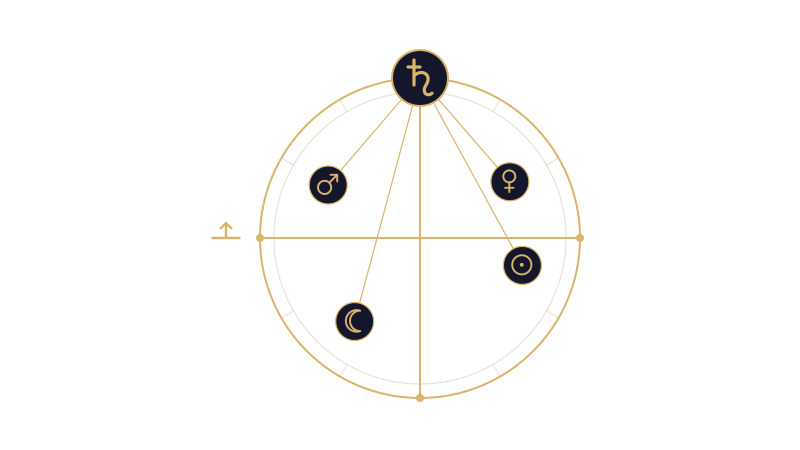
The first two clues need your birth time. The angles move about one degree every four minutes, so even a small error shifts them. Without a birth time, only the last three clues can be used.
See your own chart
Enter your birth date and get your Sun, Moon and Rising sign explained. Free, in about 60 seconds.
I was born on
See my free previewWhy there is no single formula
Astrologers largely agree on the clues. They do not agree on how much each one counts.
Some give points for every clue and add them up. Some give the angles the most weight, others the aspects or the rulers. Many give the Sun and the Moon extra weight, because they are central in every chart. Others leave those two out and look for the dominant planet among the remaining eight.
The slow planets are a further point of debate. Uranus spends about seven years in a sign, Neptune about 14 years, and Pluto between about 12 and more than 30 years. Everyone born in those years shares the sign, which is why they are called generational planets. Many astrologers count one of them as dominant only when it stands on an angle or forms a close aspect to the Sun or the Moon.
So if two sources name two different planets for you, neither has to be wrong. They weigh differently. Treat any single result as an opinion with reasons, and check the reasons in your own chart.
What each dominant planet is read as
| Dominant planet | The tone it tends to set |
|---|---|
| Sun | A clear sense of self: you want to create, to lead and to be seen for who you are. |
| Moon | Feeling comes first: you sense moods, care for others and need a safe base. |
| Mercury | A quick, curious mind: you work things out by talking, reading, writing and comparing. |
| Venus | Relationships, beauty and harmony matter a great deal, and harshness puts you off. |
| Mars | Drive and directness: you want to act, compete and move, and waiting is hard. |
| Jupiter | Optimism and generosity: you look for meaning and wide horizons and tend to take on a lot. |
| Saturn | Seriousness and patience: high standards, a long view and trust that grows slowly. |
| Uranus | Independence: you do things your own way and get restless with routine. |
| Neptune | Imagination and empathy: a pull toward music, art or the spiritual, and soft boundaries. |
| Pluto | Intensity and depth: you want to get to the bottom of things and do nothing by halves. |
Read each line as a tendency. A dominant Saturn does not make a person joyless, and a dominant Mars does not make anyone aggressive. The sign and the house of the planet show how the tone plays out, and the rest of the chart can soften or sharpen it.
How to find yours and what to do with it
- Go through the five clues and write down which planet each one points to.
- A planet that shows up three times or more is a solid candidate. If two are close, keep both.
- Read its line in the table and ask where this tone shows in your life. Then look at the sign and the house of that planet.
Keep the result in proportion. A dominant planet adds an accent. Your Sun, your Moon and your Rising sign remain the first things to read in any chart.
If you would rather have it read for you, a Birth Chart Reading is written for your chart and calculated from your exact birth data.
Questions, answered
How do I find my dominant planet?
Check which planet stands close to one of the four angles of your chart, which planet rules your Rising sign, which rules a sign with several planets in it, which has the most close aspects and which stands in its own sign. The planet that several of these clues point to is your strongest candidate.
Why do different sources give me different dominant planets?
Because there is no agreed formula. Each method gives the clues a different weight, and some leave out the Sun and the Moon or the slow outer planets. A different result is a different weighting, not an error in your chart.
Can I have more than one dominant planet?
Yes. In many charts two planets are about equally strong. Astrologers then read both and look at how they work together.
Is my dominant planet the ruler of my Sun sign?
Not necessarily. A person with the Sun in Gemini can have a dominant Saturn. The ruler of your Sun sign gains some weight, but it is only one clue among several.
Astrology is a tool for self-reflection, not a science, and it does not replace medical, psychological, legal or financial advice.
Keep reading

Planets & houses
Chart ruler: the planet in charge of your chart
Your chart ruler is the planet that rules your Rising sign. How to find it in three steps, what its sign and house add, and why it needs your birth time.
6 min readRead more →
Planets & houses
Stellium meaning: many planets, one place
A stellium is three or more planets in one sign or house of your birth chart. How to count it correctly, how astrologers read it and what it does not mean.
6 min readRead more →
Birth chart basics
Aspects in astrology: how your planets talk to each other
Aspects are the angles between planets in a chart. What conjunction, sextile, square, trine and opposition mean, what an orb is, and why a square is not bad.
6 min readRead more →
Start with your free preview
I was born on
See my free previewFree preview in 60 seconds · One payment · No subscription
For self-reflection and entertainment. Not medical, psychological, legal or financial advice.