Astrology life cycles by age: a timeline of a whole life
Some ages are marked by a planet coming back to its birth position. Which cycles astrologers follow, at what age they fall and what they are read as.
By the AstroScroll editorial team · Updated September 6, 2026 · 6 min read

In short
- Astrology marks certain ages by planets returning to, or standing opposite, the position they had at your birth.
- The main ones are the Jupiter returns around 12, 24, 36, 48, 60 and 72, the Saturn returns at about 29 and 58 to 60, the Uranus opposition at about 39 to 45 and the Chiron return at about 50.
- Because they follow from how long each body takes for one round, they come at about the same age for everyone.
- Astrologers read them as themes of a stage of life, and the sign and house in your own chart show what each one touches for you.
On this page
In astrology, certain ages are marked by a planet coming back to the place it had at your birth, or standing exactly opposite that place. The best known are the Jupiter returns about every twelve years, the Saturn returns at about 29 and 58 to 60, the Uranus opposition at about 39 to 45 and the Chiron return at about 50. Astrologers read them as themes of a stage of life, not as events that will happen.
Why certain ages stand out in astrology
Each planet needs a fixed time for one round through the zodiac. Your birth chart records where each one stood when you were born. When a planet has gone once around, it reaches that position again. This is called a return. Halfway through, it stands opposite its birth position, which is called an opposition.
Because the rounds always take the same time, these moments come at about the same age for everyone. They are the cycles you share with everyone born in your year. Astrologers read them the way you read a clock: as markers of time, not as causes.
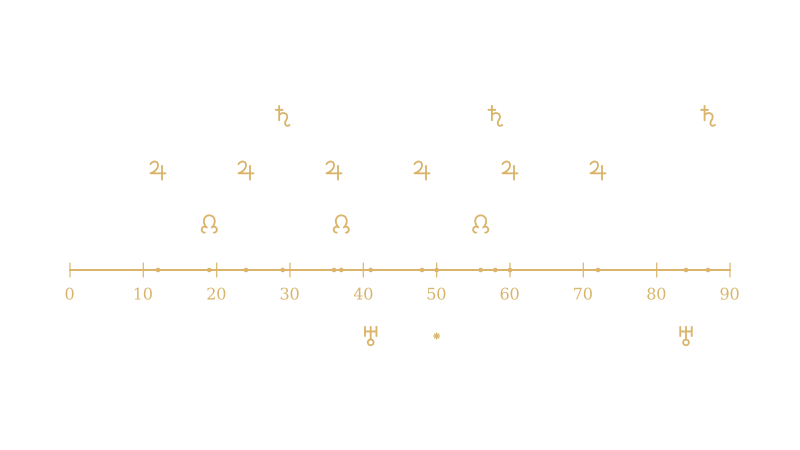
Astrology life cycles by age: the timeline
| Age | Cycle | Astrologers read it as |
|---|---|---|
| Around 12 | First Jupiter return | The world gets bigger than home |
| About 18 to 19 | First nodal return | A first direction of your own |
| Around 24 | Second Jupiter return | Trying out your own path |
| About 29 | First Saturn return | Taking stock and taking responsibility |
| Around 36 | Third Jupiter return | Widening what you have built |
| About 37 | Second nodal return | Checking the direction |
| About 39 to 45 | Uranus opposition | Questioning routines, wanting more freedom |
| Around 48 | Fourth Jupiter return | Asking what still feels meaningful |
| About 50 | Chiron return | Making peace with a tender spot |
| About 56 | Third nodal return | Setting the direction for a new stage |
| About 58 to 60 | Second Saturn return, fifth Jupiter return | What you have built, and what comes next |
| Around 72 | Sixth Jupiter return | Perspective and generosity |
| About 84 | Uranus return | One full circle |
| Around 87 to 88 | Third Saturn return | Looking back on a whole life |
The ages are approximate. The exact time depends on where the planet stood at your birth.
The five cycles behind the timeline
Jupiter: growth. Jupiter needs 11.86 years for one round, about one year per sign. Its return is read as the start of a new round of learning and confidence. What a Jupiter return means
The lunar nodes: direction. The nodes are the two points where the Moon's orbit crosses the path of the Sun. They move backward through the zodiac and need about 18.6 years for one round. The North Node is read as a direction of growth, and a nodal return as a moment to check that direction. What the North Node means
Saturn: structure. Saturn needs about 29.5 years. The first return falls between roughly 28 and 30. It is read as becoming an adult on your own terms: what is really yours, and what you are ready to be responsible for. The Saturn return in detail
Uranus: freedom. Uranus needs 84 years, so most people meet only its halfway point, at about 39 to 45, depending on the birth year. Astrologers read the Uranus opposition as a wish for change and independence. It is the astrological picture of midlife: a time for honest questions, not a crisis that has to come.
Chiron: a tender spot. Chiron is a small body between Saturn and Uranus that needs about 50 years for one round. In a chart it is read as a sensitive place that can become a strength. The Chiron return at about 50 is read as seeing that place more kindly. Chiron in the birth chart
Neptune needs about 165 years and Pluto about 248. Nobody lives to see them return.
See your own chart
Enter your birth date and get your Sun, Moon and Rising sign explained. Free, in about 60 seconds.
I was born on
See my free previewAges where several cycles meet
Some years carry more than one marker. Astrologers read them as especially dense.
- About 36 to 37: the third Jupiter return and the second nodal return. Growth and direction are asked about together.
- About 48 to 50: the fourth Jupiter return, followed by the Chiron return.
- About 56 to 60: the third nodal return, the second Saturn return and the fifth Jupiter return follow each other closely. Direction, structure and growth are all reviewed within a few years.
The ages are the same for everyone. The sign and the house are what make each cycle yours.
What makes a cycle personal
Two people of the same age go through the same cycle in different ways. In the chart, two things account for that.
The sign of the planet at your birth shows its style. Saturn in Aries is read as learning to act on your own account, Saturn in Pisces as giving a clear shape to trust and imagination.
The house shows the area of life. Houses are the twelve sections of a chart, and they depend on your birth time. A Saturn return in the fourth house is read as being about home and roots, in the tenth house about career and public role.
The exact timing is personal too. For part of every year these planets appear to move backward, seen from Earth, so a planet often crosses its birth position three times. A return is therefore a period of months, not a day. Only a calculated chart shows when yours falls.
How to use the timeline for yourself
- Find your place. Which marker was your last, and which one comes next?
- Look back. What was changing in your life around your last marker? Does the theme in the table fit?
- Look up the planet. Its sign and house in your birth chart show what the cycle touches for you.
- Hold it lightly. These are themes for reflection, not deadlines. They are no basis for medical, legal or financial decisions.
If you want all of this for your own chart, a Birth Chart Reading is calculated from your exact birth data and written for your chart.
Questions, answered
What are the most important ages in astrology?
The Saturn returns at about 29 and 58 to 60, the Uranus opposition at about 39 to 45 and the Chiron return at about 50. The Jupiter returns about every twelve years and the nodal returns at about 18 to 19, 37 and 56 add a finer rhythm.
What happens astrologically around age 29?
Saturn returns to the position it had at your birth, which is called the Saturn return. Astrologers read it as a time to take stock, take on responsibility and decide what you want to build on.
What is the astrological midlife point?
The Uranus opposition at about age 39 to 45. Uranus needs 84 years for one round, so at that age it stands opposite its birth position. Astrologers read it as a time for questioning routines and wanting more freedom.
Are these cycles the same for everyone?
The ages are about the same for everyone, because they depend on the orbits. What differs is the sign and house of each planet in your birth chart, which show the area of life a cycle touches.
Astrology is a tool for self-reflection, not a science, and it does not replace medical, psychological, legal or financial advice.
Keep reading
Planets & houses
Saturn return: what it is and when yours happens
A Saturn return is when Saturn comes back to where it stood at your birth, at about 29, 58 and 87. What it means, how long it lasts and who has one in 2027.
6 min readRead more →
The year ahead
Jupiter return: every twelve years, a new round of growth
A Jupiter return is when Jupiter comes back to where it stood at your birth, around ages 12, 24, 36, 48, 60 and 72. What it means and how to find yours.
6 min readRead more →
The year ahead
What is a transit? The moving sky meets your birth chart
A transit is a planet in the sky of a given day meeting a point in your birth chart. How fast and slow transits differ and how astrologers read them.
6 min readRead more →
Start with your free preview
I was born on
See my free previewFree preview in 60 seconds · One payment · No subscription
For self-reflection and entertainment. Not medical, psychological, legal or financial advice.