What astrology can and cannot do
An honest look at what a birth chart is good for, where its limits lie, and how to read a reading with a clear head.
By the AstroScroll editorial team · Updated May 19, 2026 · 6 min read

In short
- Astrology is a symbolic language read from real, calculated positions in the sky. It is a tool for self-reflection, not a natural science and not a forecast.
- A reading can give you words for your patterns, a reason to stop and think, and a new angle on tensions you already know.
- It cannot predict events, tell you whether a relationship will last, or describe everything about you.
- It must never decide a medical, legal or financial question, and it should not be used to judge or sort other people.
On this page
Astrology can give you a language for your own patterns and a structured occasion to think about them. It cannot predict events, and it must never decide a medical, legal or financial question. Read as a description of tendencies, a birth chart is a useful tool for self-reflection. Read as a forecast, it promises more than it can hold.
What astrology is, and what it is not
Every chart has two layers, and it helps to keep them apart.
The first layer is calculation. Where the Sun, the Moon and the planets stood at the minute and place of your birth is a matter of astronomy. It is exact, and anyone who calculates it correctly gets the same result.
The second layer is interpretation. What those positions are read as is a symbolic language that has grown over many centuries: Mars stands for drive, the Moon for what you need, the seventh house for partnership. These meanings are a tradition. They are not measurements: astrology is not a natural science and does not claim to be one.
A responsible reading therefore does not claim that planets cause anything in your life. It uses the sky at your birth as a detailed set of symbols for describing a person. The guide to astrology and astronomy explains where the two meet and where they part. What the map itself contains is covered in what a birth chart is.
What a reading can give you
- Words for your patterns. Many people know that they react in a certain way and have never had a name for it. A chart offers names: a need for quiet before you can talk, a habit of deciding fast and doubting later.
- A reason to stop and think. A full reading has about 40 pages on how you love, work and decide. Few people otherwise spend an evening on those questions.
- A new angle on an old tension. With the Sun in Sagittarius and the Moon in Cancer, wanting freedom and needing a home are not a fault to repair. They are two parts of you that have to be arranged.
- A shared vocabulary. Partners and families can talk about differences with less blame: one needs to talk it through at once, the other needs a quiet day first.
- A sense of rhythm. Astrologers compare the moving sky with your chart and read certain periods as a time for certain themes. These transits are prompts for questions, not forecasts.
See your own chart
Enter your birth date and get your Sun, Moon and Rising sign explained. Free, in about 60 seconds.
I was born on
See my free previewWhat astrology cannot do
- Predict events. No chart shows a new job, a move or a meeting. It describes themes, and themes can play out in many ways.
- Tell you whether a relationship will last. Comparing two charts describes how two people tend to meet each other. Whether it works is decided by the two people.
- Describe all of you. Your upbringing, your culture, your experiences and your choices are not in the chart. Two people born in the same minute in the same place share a chart and still live different lives.
- Prove itself by feeling true. Friendly, general sentences feel accurate to almost everyone. That a text fits is not yet a sign that it is about you.
- Replace a professional. A chart knows nothing about your body, your contract or your bank account.
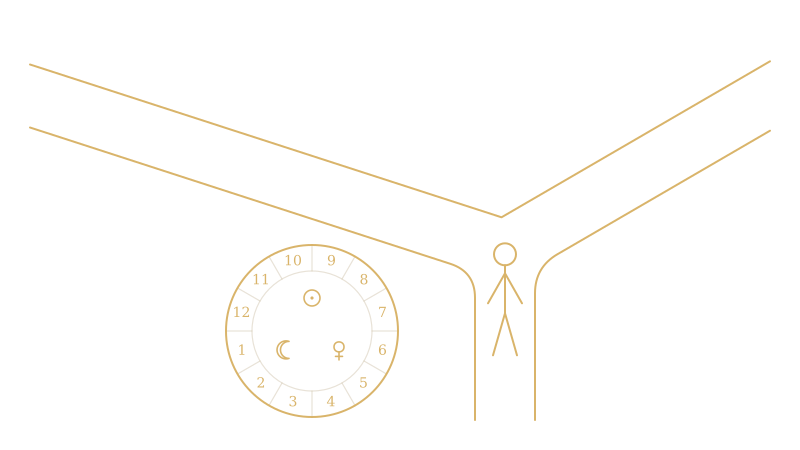
A chart can describe the person standing at the crossroads. It cannot tell you which road to take.
What astrology must never be used for
Some questions do not belong in a reading at all, however the chart looks.
| The question | Where it belongs |
|---|---|
| Should I start, stop or change a treatment? | With a doctor |
| Should I sign this, or take this to court? | With a lawyer |
| Should I invest, borrow or put my savings into this? | With a qualified financial adviser and your own numbers |
| I have been feeling low for weeks. What is wrong with me? | With people you trust and with professional support |
| Should we hire this person? | With what the person has done and can do |
| Who will my child become? | With your child, over time |
The last two rows matter as much as the first four. A chart is made for the person it belongs to. Used on others, to filter applicants, to rule out a date by sign or to fix a label on a child, a sign becomes a prejudice with a birthday attached.
How to read a reading with a clear head
- Read "tends to", not "is". Every statement in a reading describes a leaning. You decide what you do with it.
- Check it against your life. Keep what you recognize and set aside what you do not. You are the one who knows.
- Test how specific it is. Would the sentence fit your sister or your best friend just as well? Then it tells you little. A statement that is specific enough to disagree with is worth more.
- Notice what you want to hear. It is easy to remember the sentences that fit and to forget the ones that do not.
- Do not decide on the day you read it. Let it sit. An insight that still holds a week later is yours, wherever it came from.
- Put down anything that frightens you. A text that scares you or pushes you to act quickly claims to know more than a chart can show.
What to do next
Start with your own chart, and bring questions instead of expectations. Three good ones: What do I need that I rarely ask for? Where do two parts of me pull in different directions? What do I do easily that I take for granted?
The guide on how to read a birth chart shows the order in which to look. If you would rather have it written out, a Birth Chart Reading is calculated from your exact birth data and written for your chart, in twelve chapters that describe tendencies and leave the decisions to you.
Questions, answered
Can astrology predict the future?
No. A chart describes tendencies and themes, not events. When astrologers look at a period of time, they read it as a time for certain questions, not as a forecast of what will happen.
Is astrology a science?
No. The positions of the planets in a chart are calculated astronomically and are exact. The meanings given to them are a symbolic tradition, not a scientific finding.
What is a birth chart reading good for?
For reflection. It gives you a structured description of tendencies that you can compare with your own experience: what you need, how you decide and where you tend to get in your own way.
Should I make decisions based on my horoscope?
Use it to think, not to decide. Health, legal and money questions belong with qualified professionals, and personal decisions belong with you and the people they affect.
Astrology is a tool for self-reflection, not a science, and it does not replace medical, psychological, legal or financial advice.
Keep reading

Birth chart basics
Astrology vs astronomy: one sky, two different questions
Astronomy is the science of the sky. Astrology is a symbolic language that reads the positions of the planets as a picture of character. Where the two meet.
6 min readRead more →
Birth chart basics
Why your horoscope does not fit
A Sun-sign horoscope is written for everyone born in the same 30 days. Why it so often misses you, and what your Moon, Rising sign and full chart add.
6 min readRead more →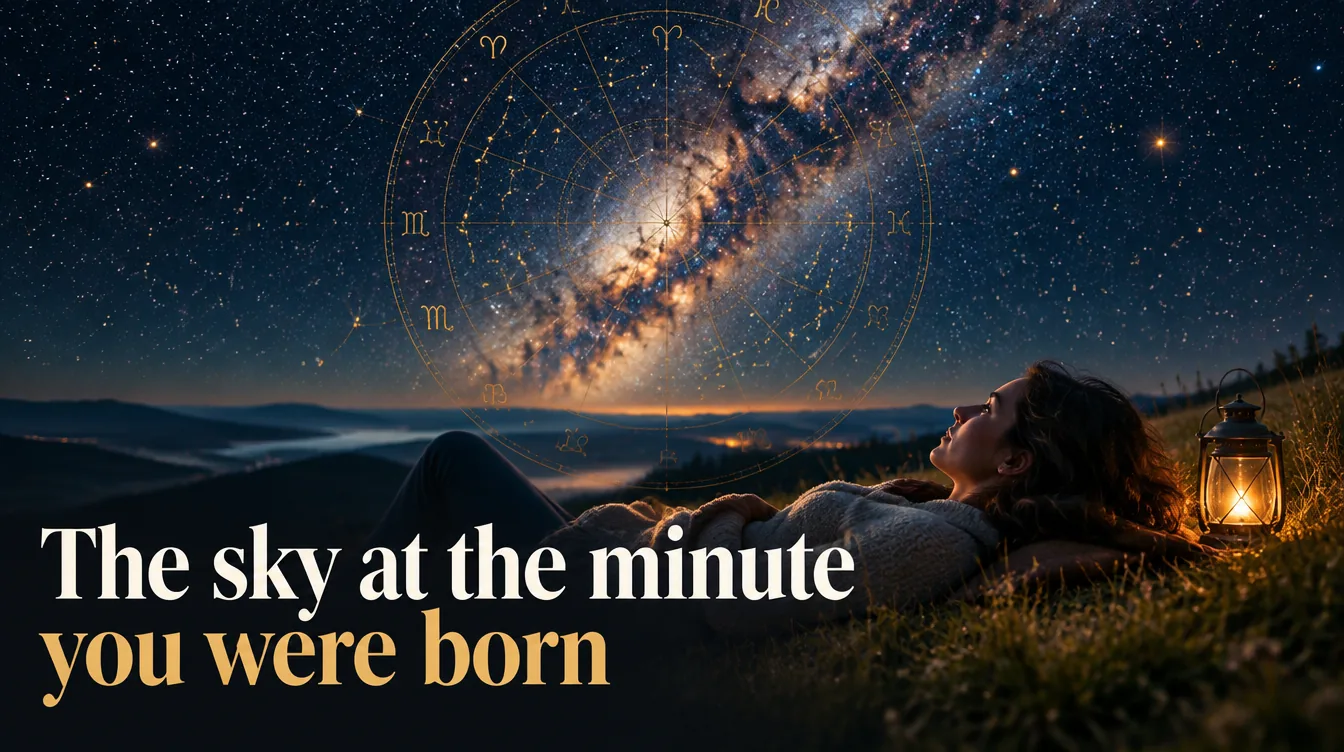
Birth chart basics
What is a birth chart?
A birth chart is a map of the sky at the exact minute and place you were born. What it shows, what you need to calculate one, and how to start reading yours.
6 min readRead more →
Start with your free preview
I was born on
See my free previewFree preview in 60 seconds · One payment · No subscription
For self-reflection and entertainment. Not medical, psychological, legal or financial advice.