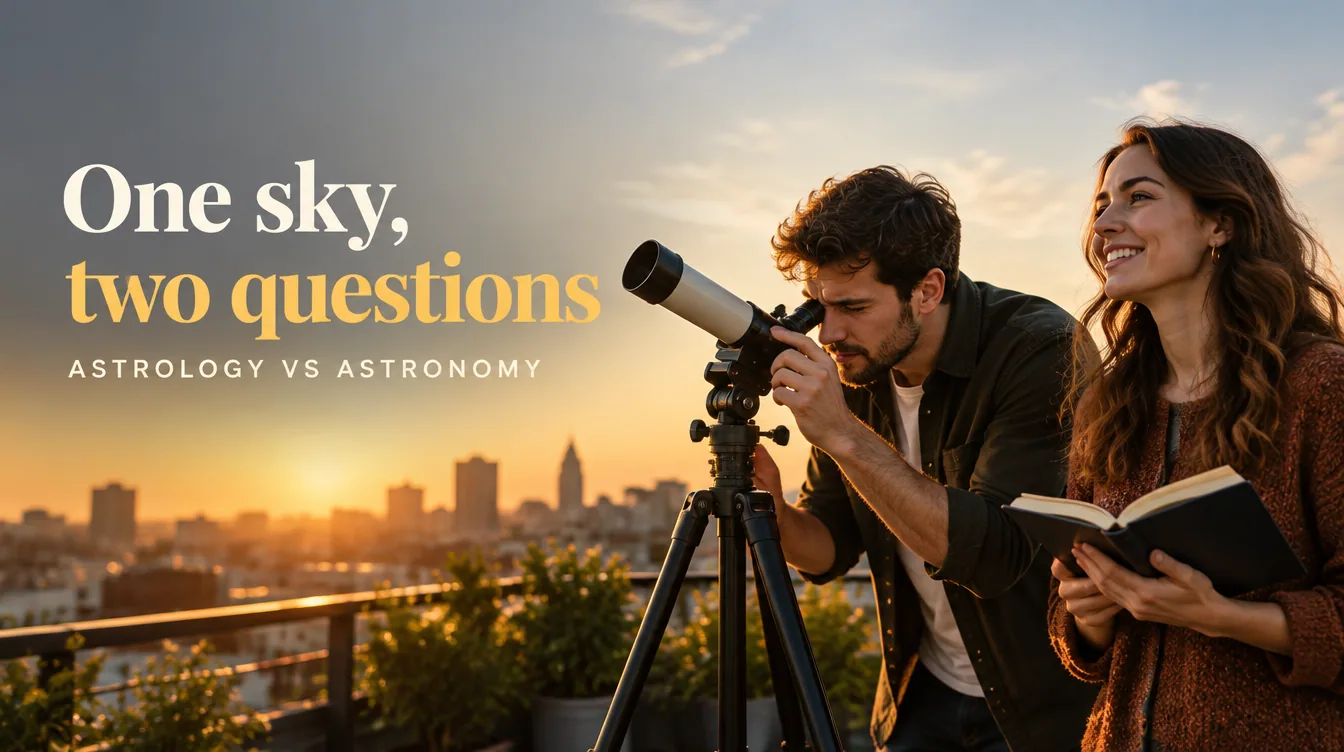
Astrology vs astronomy: one sky, two different questions
Astronomy measures where the planets are and what they are made of, and astrology reads their positions as a language of symbols.
By the AstroScroll editorial team · Updated June 16, 2026 · 6 min read
In short
- Astronomy is a natural science. It measures and explains what stars and planets are, where they are and how they move.
- Astrology is a symbolic language. It reads the positions of the Sun, the Moon and the planets as a description of character and of themes in a life.
- Astrology takes its positions from astronomy: a birth chart is a calculated map of the sky.
- Astrology is not a natural science and does not claim to be one. It predicts no events and serves as a tool for self-reflection.
On this page
Astronomy is the science of the sky: it measures and explains what stars and planets are, where they are and how they move. Astrology is a symbolic language: it reads the positions of the Sun, the Moon and the planets at a given moment as a description of character and of themes in a life. Astrology uses astronomy for its calculations. It is not a natural science and does not claim to be one, and it does not predict events.
The difference between astrology and astronomy in one example
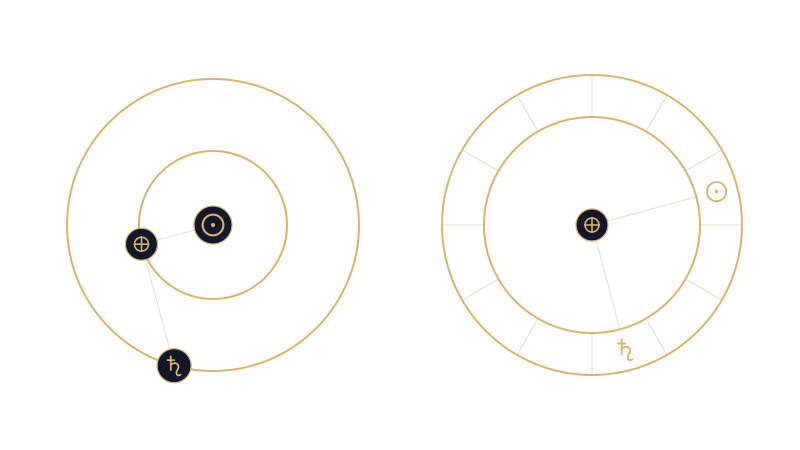
Take Saturn. An astronomer says: Saturn is a giant planet with rings, and it takes about 29.5 years to circle the Sun once. Anyone with a telescope and enough patience can check that.
An astrologer says: when Saturn comes back to the place it had at your birth, at about age 29, that is read as a time of taking stock and growing up. The first half of that sentence is astronomy. Saturn does return after about 29.5 years. The second half is interpretation. It comes from a long tradition of reading the sky as a set of symbols, not from measurement. What the Saturn return is read as
Astronomy tells you where Saturn is. Astrology asks what that could mean for you.
| Astronomy | Astrology | |
|---|---|---|
| What it is | A natural science | A symbolic language and a tradition of interpretation |
| Its question | What is out there, and how does it work? | What can the sky of one moment say about a person? |
| Its method | Observation, measurement, physics | Calculated positions, read by rules handed down over centuries |
| What it gives you | Facts that anyone can check | Descriptions of tendencies and questions to think about |
| What it does not give you | A meaning for your own life | Proof, forecasts of events or advice |
For a long time the two were one occupation: the people who calculated the planets also interpreted them. They parted when astronomy became a modern science built on measurement and physics.
Where astrology uses real astronomy
A birth chart is a calculated map of the sky for one time and one place. Every position can be checked against astronomical data.
- The positions. Where the Sun, the Moon and each planet stood at your birth is calculated, in degrees, the way an astronomer would calculate it.
- The Rising sign. It is the sign that was coming up on the eastern horizon, also called the Ascendant. Because the Earth turns, this point moves about one degree every four minutes. That is why a chart needs an exact birth time.
- Retrogrades. No planet ever moves backward. A retrograde is an apparent backward motion seen from the moving Earth. Mercury shows it about three times a year, for about three weeks each time.
- Eclipses. A solar eclipse happens only at New Moon, a lunar eclipse only at Full Moon, and only when the Moon is close to its nodes, the two points where its orbit crosses the path of the Sun.
- The cycles. The Moon circles the zodiac in about 27.3 days, Jupiter in about 12 years, Saturn in about 29.5 years.
Where astrology goes its own way
The calculation is astronomy. Several things around it are not.
- Signs are not constellations. The zodiac signs are twelve equal sections of 30 degrees, measured from the March equinox. Constellations are star patterns of very different sizes. Astronomers count 88 of them, and 13 lie on the Sun's path. When astrology says that Saturn is in Aries from February 14, 2026 to April 12, 2028, it means the section, not the star pattern. (Dates are in Universal Time and can shift by a day depending on where you live.) Why there is no 13th zodiac sign
- The Earth sits in the middle. A chart is drawn around the Earth because it shows the sky as seen from your birthplace. It does not claim that the Sun circles the Earth.
- The word planet. Astrology calls the Sun and the Moon planets, for short. To an astronomer the Sun is a star and the Moon is a moon. Pluto, which astronomers classify as a dwarf planet, stays a planet in astrology.
- The meaning. Astronomy gives Saturn a size, rings and an orbit. Astrology gives it themes: structure, responsibility, time. These themes are symbols. No instrument measures them.
There is even more than one way to lay the signs over the sky. How the tropical and the sidereal zodiac differ
See your own chart
Enter your birth date and get your Sun, Moon and Rising sign explained. Free, in about 60 seconds.
I was born on
See my free previewWhat astrology is not, and what it is good for
- Astrology is not a natural science. It does not claim to be one. Its meanings come from tradition and interpretation, not from measurement.
- It is not a force. Astrology is best understood as a language. It reads the sky the way you read a clock face: the hands show the hour, they do not cause it.
- It is not a forecast. A chart describes tendencies, not events. Astrologers read a Saturn return as a time for taking stock. What you do in that time is up to you.
- It is not advice. Decisions about health, law or money belong with the people trained for them.
What is left is still worth having. Astrology offers a rich, ordered vocabulary for thinking about yourself: what you need, how you act under pressure, where you tend to hold back. Its value lies in the questions it puts to you. You stay the judge of whether a description fits. What astrology can and cannot do
How to tell the two apart in practice
One test works almost every time. If a sentence can be checked with a telescope or a calculation, it is astronomy. If it speaks about meaning for a person, it is astrology.
- "Mercury turns retrograde about three times a year." Astronomy.
- "A Mercury retrograde is read as a time to review and recheck." Astrology.
- "The Moon was in the section of the zodiac called Cancer when you were born." Astronomy, with an astrological name for the place.
- "A Cancer Moon suggests that you need a familiar place to feel safe." Astrology.
What to do next with your own chart
Look at your chart twice. First the astronomy: where did the Sun, the Moon and the planets stand when you were born, and which sign was rising? Then the astrology: read what each position is said to describe, and ask honestly where you recognize yourself and where you do not.
Used this way, a chart is neither proof nor prophecy. It is a set of good questions with your birth data on it.
Questions, answered
What is the difference between astrology and astronomy?
Astronomy is the science that measures and explains the sky. Astrology is a tradition of interpretation that reads the positions of the planets as symbols for character and life themes. Astronomy asks how the sky works, astrology asks what it could mean for a person.
Is astrology a science?
No. Astrology is not a natural science and does not claim to be one: it takes its positions from astronomical calculation and its meanings from tradition. It is a symbolic language for self-reflection.
Does astrology use real astronomy?
Yes. The positions of the Sun, the Moon and the planets in a birth chart are calculated astronomically, and so are retrogrades, eclipses and the Rising sign. The interpretation of these positions is not astronomy.
Were astrology and astronomy once the same thing?
For a long time they were one occupation: the people who calculated the positions of the planets also interpreted them. They parted when astronomy became a modern science built on measurement and physics.
Astrology is a tool for self-reflection, not a science, and it does not replace medical, psychological, legal or financial advice.
Keep reading

Birth chart basics
What astrology can and cannot do
Astrology is a tool for self-reflection, not a way to predict events. What a reading can give you, what it must never decide, and how to read it clearly.
6 min readRead more →
Birth chart basics
Tropical vs sidereal zodiac: two starting points for one sky
The tropical zodiac starts at the March equinox, the sidereal zodiac is tied to the stars. They are about 24 degrees apart, so most Sun signs shift by one.
6 min readRead more →
Birth chart basics
Ophiuchus: is there a 13th zodiac sign?
No, there is no 13th zodiac sign. Ophiuchus is a constellation on the Sun's path, but zodiac signs are twelve equal sections of the sky. Your sign is unchanged.
6 min readRead more →
Start with your free preview
I was born on
See my free previewFree preview in 60 seconds · One payment · No subscription
For self-reflection and entertainment. Not medical, psychological, legal or financial advice.