Tropical vs sidereal zodiac: two starting points for one sky
Western astrology measures the zodiac from the March equinox, Vedic astrology measures it from the stars, and the two scales are about 24 degrees apart.
By the AstroScroll editorial team · Updated April 22, 2026 · 6 min read

In short
- The tropical zodiac starts at the March equinox and follows the seasons. Most Western astrology uses it.
- The sidereal zodiac is tied to the stars. Vedic astrology uses it.
- The two are about 24 degrees apart, so most people's Sun is one sign earlier in the sidereal zodiac.
- Neither is wrong. They are two reference frames for the same sky, and each belongs to its own tradition.
On this page
The tropical zodiac starts at the March equinox and is the one most Western astrology uses. The sidereal zodiac is tied to the stars and is used in Vedic astrology, the astrological tradition of India. The two are about 24 degrees apart, so most people's Sun is one sign earlier in the sidereal zodiac. Neither is wrong: they are two reference frames for the same sky.
What tropical and sidereal mean
Both zodiacs are a circle of 360 degrees, divided into twelve signs of 30 degrees. The signs have the same names and the same order. The only difference is where the circle begins, the point called 0° Aries.
- Tropical zodiac. 0° Aries is the place where the Sun stands at the March equinox, the moment around March 20 or 21 when day and night are about equally long. The exact day depends on the year and on your time zone. This zodiac is anchored to the seasons. The word has nothing to do with a tropical climate: it comes from the Greek word for turning and refers to the turning points of the Sun in the course of the year.
- Sidereal zodiac. 0° Aries is a fixed place among the stars. "Sidereal" means "of the stars". This zodiac is anchored to the starry background.
| Tropical zodiac | Sidereal zodiac | |
|---|---|---|
| Starting point | The March equinox | A fixed place among the stars |
| Anchored to | The seasons | The stars |
| Used by | Most Western astrology | Vedic astrology |
| Division | Twelve signs of 30 degrees | Twelve signs of 30 degrees |
| Over the centuries | Stays with the seasons, drifts against the stars | Stays with the stars, drifts against the seasons |
This guide uses the tropical zodiac throughout. The zodiac sign dates you know from Western horoscopes are tropical dates.
Why the two zodiacs drift apart: precession
Earth's axis is not perfectly steady. It wobbles very slowly, like the axis of a spinning top that traces a small circle while the top spins. One full wobble takes about 26,000 years. Astronomers call this precession.
This wobble has a consequence for the equinox: the place among the stars where the Sun stands at the March equinox slides slowly backward, by about one degree every 72 years. The tropical zodiac moves with the equinox, while the sidereal zodiac stays with the stars. So the two scales slide against each other.
In a human lifetime of 72 years that is one single degree. Over the centuries it adds up. In the 21st century the gap is about 24 degrees. At one degree every 72 years, that means the two zodiacs lined up roughly 1,700 years ago.
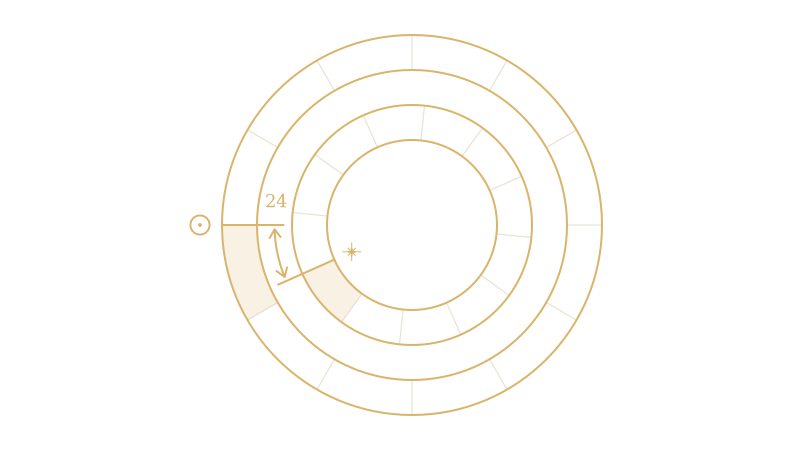
The exact size of the gap depends on which place among the stars is taken as the anchor. Sidereal schools differ slightly on this, so their figures differ slightly too.
What changes in your chart and what stays the same
Every position shifts by the same amount. The Sun, the Moon, each planet and the Rising point, the degree that was coming up in the east at your birth, all move back about 24 degrees. A sign is 30 degrees wide, and the Sun moves about one degree per day. That gives a simple rule:
| Where your Sun stands in its tropical sign | Your Sun in the sidereal zodiac |
|---|---|
| In the first 24 degrees, roughly the first 24 days of the sign | One sign earlier |
| In the last 6 degrees, roughly the last 6 days of the sign | The same sign |
Two examples. A Sun at 10° Leo in the tropical zodiac stands at 16° Cancer in the sidereal one. A Sun at 27° Leo stands at 3° Leo and keeps its sign. The same arithmetic applies to your Moon sign and your Rising sign, also called the Ascendant.
What stays the same:
- The sky itself. Both zodiacs describe the same Sun, Moon and planets at the same moment.
- The aspects. These are the angles between the planets. Because everything shifts by the same amount, no angle changes.
- The timing. A Full Moon or an eclipse happens at the same moment in both zodiacs. Only the sign named for it differs.
One thing does not carry over: the descriptions. What this guide says about Leo was written for the tropical Leo. Vedic astrology is a complete system of its own. It gives the Moon and the Rising sign more weight than the Sun sign and works with its own techniques. Taking a sidereal position and reading a Western description for it mixes two languages.
See your own chart
Enter your birth date and get your Sun, Moon and Rising sign explained. Free, in about 60 seconds.
I was born on
See my free previewIs one of the two zodiacs wrong?
No. Think of Celsius and Fahrenheit. A room at 20 degrees Celsius is a room at 68 degrees Fahrenheit. Both numbers are correct, and the room is equally warm either way. The only mistake is to mix the scales.
The planets stand where they stand. The two zodiacs only disagree about where to start counting.
Each scale has its own logic. The tropical zodiac follows the year: the Sun enters Aries at the March equinox, Cancer at the June solstice, Libra at the September equinox and Capricorn at the December solstice. The sidereal zodiac follows the stars you can see at night.
A common objection goes: "The signs no longer match the constellations." For the tropical zodiac that is true, and it is by design. Its signs are named after constellations but measured from the equinox. The sidereal signs are not the constellations either. They are twelve equal sections of 30 degrees, while the real star patterns have very different sizes. That is also why the story of a 13th zodiac sign changes neither zodiac.
Which scale says something true about a person cannot be settled by looking through a telescope. Astrology is a symbolic language and a tool for self-reflection, not a measurement of forces. How astrology differs from astronomy
What to do next with your own chart
- If you read Western astrology, stay with the tropical zodiac. Your sign is the one you have always known.
- If Vedic astrology interests you, use the sidereal zodiac and read it in its own tradition.
- Find the exact degree of your Sun. A calculated birth chart shows it, and with the rule above you can see at once whether your sign differs between the two.
A Birth Chart Reading is calculated from your exact birth data and written for your chart.
Questions, answered
Why is my zodiac sign different in Vedic astrology?
Vedic astrology uses the sidereal zodiac, which is tied to the stars. It is shifted by about 24 degrees against the tropical zodiac of Western astrology, so most Sun positions fall one sign earlier.
Which zodiac is correct, tropical or sidereal?
Neither is wrong. Both divide the same sky into twelve signs of 30 degrees and only start counting at different points. Each one belongs to its own tradition and should be read within it.
How far apart are the tropical and the sidereal zodiac?
About 24 degrees. The gap grows by about one degree every 72 years, because of precession, a slow wobble of Earth's axis.
Do my Moon sign and Rising sign change too?
Yes. Every position in the chart shifts by the same amount of about 24 degrees. The angles between the planets, the aspects, stay exactly the same.
Astrology is a tool for self-reflection, not a science, and it does not replace medical, psychological, legal or financial advice.
Keep reading

Birth chart basics
Zodiac sign dates, and why there is no cusp sign
The dates of all twelve zodiac signs, why they shift by a day from year to year, and what being born on the cusp really means: the Sun is in one sign only.
6 min readRead more →
Birth chart basics
Ophiuchus: is there a 13th zodiac sign?
No, there is no 13th zodiac sign. Ophiuchus is a constellation on the Sun's path, but zodiac signs are twelve equal sections of the sky. Your sign is unchanged.
6 min readRead more →
Birth chart basics
Astrology vs astronomy: one sky, two different questions
Astronomy is the science of the sky. Astrology is a symbolic language that reads the positions of the planets as a picture of character. Where the two meet.
6 min readRead more →
Start with your free preview
I was born on
See my free previewFree preview in 60 seconds · One payment · No subscription
For self-reflection and entertainment. Not medical, psychological, legal or financial advice.