Birth chart basics
Your child's birth chart: what it can tell you
A language for your child's temperament, the four parts that matter most early on, and the clear limits of what a chart can say.
By the AstroScroll editorial team · Updated October 3, 2026 · 6 min read

In short
- A child's birth chart is the map of the sky for the minute and place your child was born.
- It gives parents a language for temperament: how a child takes in the world, what calms them and how they learn.
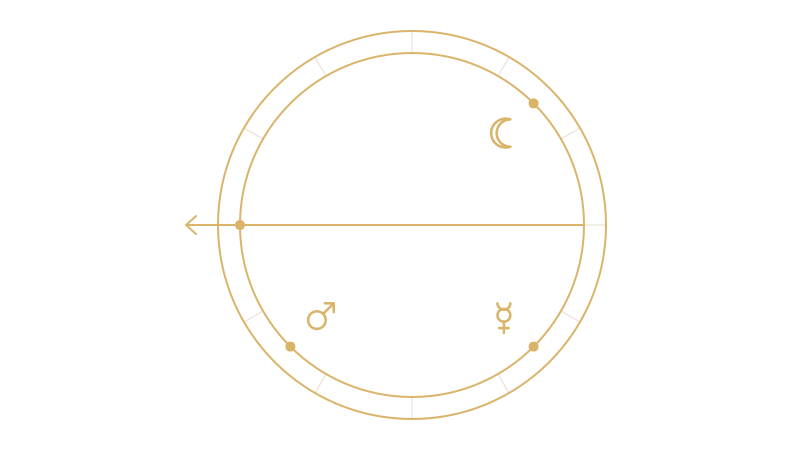
- Early on, four parts are easiest to observe: the Moon, Mercury, Mars and the Rising sign.
- A chart is not a label, a diagnosis or a forecast. Your child is always more than a chart.
On this page
A child's birth chart is the map of the sky for the minute and the place your child was born. For parents it offers a language for temperament: how a child takes in the world, what calms them and how they learn. It describes tendencies, not a future, and it never replaces what you see in your child every day.
What a child's birth chart can offer
Your child's zodiac sign is the position of the Sun on the day of birth. About one child in twelve shares it. The birth chart adds the Moon, the planets and the Rising sign, the sign that was coming up over the eastern horizon at the minute of birth. Read together, they describe a temperament rather than a type.
That is what parents can use it for. Not to find out who a child will become, but to find words for what is already there:
- How your child takes in the world. Quickly or slowly, through talking, touching, watching or trying.
- What calms them. Closeness, quiet, movement, a fixed routine or an explanation.
- How they learn. Step by step or in leaps, alone or in company, by listening or by doing.
Many parents know the situation: two children, the same home, the same rules, and one needs the opposite of the other. A chart does not prove why. It gives you a calm, neutral way to describe the difference, without one child being "the easy one" and the other "the difficult one".
Which parts of the chart matter most early on
In an adult's chart, astrologers usually begin with Sun, Moon and Rising sign. With a young child, four parts are especially easy to observe in daily life.
| Part of the chart | Stands for | The question it answers |
|---|---|---|
| Moon | Needs and comfort | What helps my child feel safe and calm down? |
| Mercury | Learning and speaking | How does my child take things in and put them into words? |
| Mars | Energy and frustration | How does my child use energy, and what does frustration look like? |
| Rising sign | First reactions | How does my child meet new people and new situations? |
The Moon: needs and comfort
The Moon stands for feelings and for what a person needs to feel safe. With small children, astrologers often read it first, because needs come before words. A child with the Moon in Taurus tends to settle through routine, physical closeness and familiar things. A child with the Moon in Gemini often settles by talking or by having something new to look at. How to find a Moon sign
Mercury: learning and speaking
Mercury stands for thinking, learning and talking. It is never more than about 28 degrees from the Sun, so your child's Mercury sign is the Sun sign or a neighboring sign. Mercury in Virgo is read as learning step by step and wanting to get the details right. Mercury in Sagittarius is read as grasping the big picture first and asking "why" before "how".
Mars: energy and frustration
Mars stands for drive: how a person goes after things, and what happens when something is in the way. Mars in Aries tends to flare up fast and be done with it just as fast. Mars in Cancer tends to turn frustration inward, as withdrawal or a mood, and needs a moment before it can say what was wrong.
The Rising sign: first reactions
The Rising sign, also called the Ascendant, describes the instinctive first reaction to something new. A child with Leo Rising tends to walk in and join. A child with Virgo Rising tends to watch from the edge first and join once it is clear how things work.
See your own chart
Enter your birth date and get your Sun, Moon and Rising sign explained. Free, in about 60 seconds.
I was born on
See my free previewWhat a child's birth chart is not
The limits matter more here than in any other kind of chart, because the person it describes cannot yet speak for themselves.
- Not a label. "She is a Scorpio, so she is ..." closes a question that should stay open. Children change, and they notice when an adult has made up their mind about them.
- Not a diagnosis. A chart says nothing about development, health or learning difficulties. If something worries you, talk to your pediatrician, a teacher or a psychologist. A chart never replaces them.
- Not a forecast. A chart does not show how a child will do in school, what they will become or how their life will go.
- Not the whole child. Family, friends, experiences and a child's own choices shape who they are. A child is always more than a chart.
A child's chart is useful when it gives you a better question. It is misused when it gives you a ready answer.
How to use a child's chart well
- Observe first. Before you read anything, write down what you already know: what calms your child, what upsets them, how they start something new.
- Then compare. Read the chart and see where it matches your notes and where it does not. Where the two differ, trust what you see.
- Ask better questions. Instead of "Why is he so stubborn?", try "Does he need more time to switch from one thing to the next?".
- Look at your own chart too. Where your Moon differs from your child's, your way of calming down is probably not theirs.
- Keep it between adults. A young child does not need to hear what their chart says. When they are older and curious, it is theirs to explore.
Next step: find the birth time and start with the Moon
The birth time is usually on the birth certificate or in the hospital record. In the United States, the long-form birth certificate usually shows it. Use the written time rather than a remembered one: the Rising sign changes about every two hours, and the Rising point moves about one degree every four minutes.
If you cannot find the time, the chart can still be read. It then leaves out the Rising sign and the houses, and if the Moon changed signs that day, both signs are possible. What a chart shows without a birth time
Then start small. Look up your child's Moon sign, watch for a week or two, and see what you recognize. If you would like the whole chart read, the Talents & Learning Reading is written for parents about their child.
Questions, answered
What does my child's zodiac sign mean?
The zodiac sign is the position of the Sun on the day of birth and describes the qualities a child grows into. It is one part of the chart. The Moon, Mercury, Mars and the Rising sign add how your child feels, learns, acts and meets new things.
Do I need the exact birth time for a baby's birth chart?
For the Rising sign and the houses, yes. The Rising sign changes about every two hours. Without a birth time the chart still works and leaves those two out.
Where do I find my child's birth time?
Usually on the birth certificate or in the hospital record. In the United States, the long-form birth certificate usually shows the time of birth.
Can a birth chart tell me how my child will do in school?
No. A chart describes tendencies, such as how a child likes to learn. It does not forecast results, and it never replaces a teacher, a pediatrician or a psychologist.
Astrology is a tool for self-reflection, not a science, and it does not replace medical, psychological, legal or financial advice.
Keep reading

Sun, Moon & Rising
What is my Moon sign?
Your Moon sign is the zodiac sign the Moon was in when you were born. It describes your feelings and needs. What it means, and what you need to find yours.
6 min readRead more →
Sun, Moon & Rising
Sun, Moon and Rising: your Big Three
Your Big Three are your Sun, Moon and Rising sign. What each one means, how the three work together, and what you need to find yours.
6 min readRead more →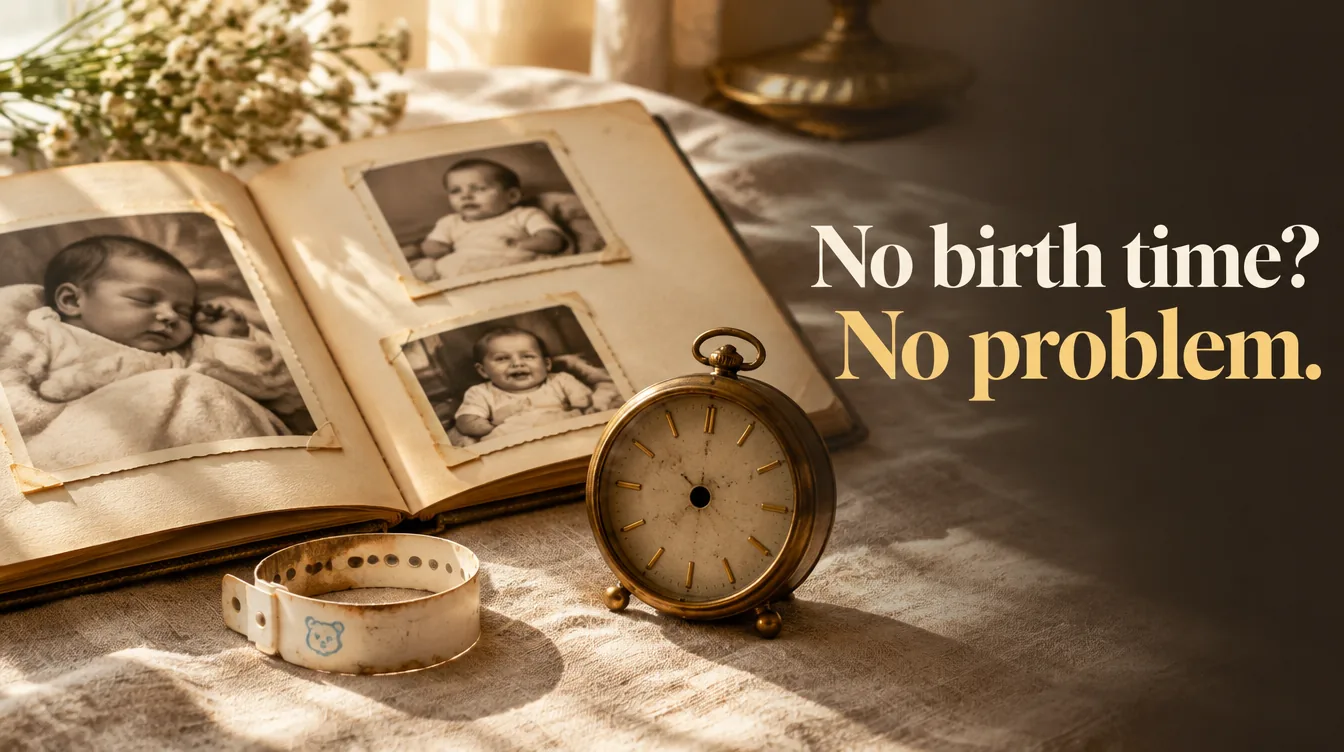
Birth chart basics
A birth chart without a birth time
Yes, a birth chart works without a birth time. The planets keep their signs, but the Rising sign and houses are missing. Plus: how to find your birth time.
6 min readRead more →
Start with your free preview
I was born on
See my free previewFree preview in 60 seconds · One payment · No subscription
For self-reflection and entertainment. Not medical, psychological, legal or financial advice.