House systems explained: one sky, four ways to divide it
Placidus, Whole Sign, Equal and Koch cut the same sky into twelve houses in different ways, and only the house borders move.
By the AstroScroll editorial team · Updated March 25, 2026 · 6 min read

In short
- A house system is the method used to divide a birth chart into its twelve houses.
- Placidus and Koch divide by time and give houses of unequal size. Whole Sign and Equal give twelve houses of 30 degrees each.
- All house systems share the same Rising sign, and no planet ever changes its sign. Only the house of a planet can change.
- There is no single right system, and astrologers disagree about it. If a planet changes house, read both houses and see which description you recognize.
On this page
A house system is the method used to divide a birth chart into its twelve houses, the sections that stand for areas of life. The four you will meet most often are Placidus, Whole Sign, Equal and Koch. They all start from the same Rising sign and leave every planet in the same sign. What can change is the house a planet falls in.
What a house system is
A birth chart has two layers. The first is the zodiac: twelve signs of 30 degrees each, with the Sun, the Moon and the planets at exact positions.
The second layer is the houses. They belong to the minute and the place of your birth, because they begin at the Rising point, the degree of the zodiac that was coming up on the eastern horizon. Its sign is your Rising sign, also called the Ascendant. What the twelve houses mean
The sky offers only two clear markers for the houses: the horizon, and the Midheaven, the point of the zodiac that stood highest in the sky. Nothing marks the borders in between. Where to draw them is a question of method, and each method is a house system.
A house system changes where the borders are drawn, never where the planets stand.
Placidus, Whole Sign, Equal and Koch compared
| House system | How it divides the chart | Size of the houses | Midheaven |
|---|---|---|---|
| Placidus | By time, from the Rising point | Unequal | Start of the tenth house |
| Koch | By time, with a different calculation | Unequal | Start of the tenth house |
| Whole Sign | By sign: the Rising sign is the first house | 30 degrees each | A point of its own |
| Equal | By degree: 30 degrees from the Rising degree | 30 degrees each | A point of its own |
Placidus and Koch: dividing by time
Placidus is the most common house system in modern Western astrology, and the one this guide works with. It measures time: how long a degree of the zodiac needs to climb from the horizon to its highest point. That span is split into three equal parts, and the same is done below the horizon.
Because the signs rise at different speeds, the houses come out in different sizes: one can be wider than a whole sign, another much narrower.
Placidus has one weak spot. Near and beyond the polar circles, parts of the zodiac never rise or never set, and the calculation breaks down.
Koch is time-based like Placidus, with the same Rising point and Midheaven and different borders in between.
Whole Sign and Equal: twelve houses of 30 degrees
Whole Sign is the oldest house system and the simplest. The sign that holds the Rising point is the first house, from its first degree to its last. The next sign is the second house, and so on. House borders and sign borders are the same lines.
Equal houses are also 30 degrees wide, but the count starts at the exact Rising degree. With a Rising point at 25° Leo, the first house runs from 25° Leo to 25° Virgo.
In both systems the Midheaven is no longer the start of the tenth house. It stays in the chart as a point of its own, often in the tenth house, sometimes in a neighboring one, and is still read for career and public role. What your Midheaven says about your career
Why a planet can change house but never its sign
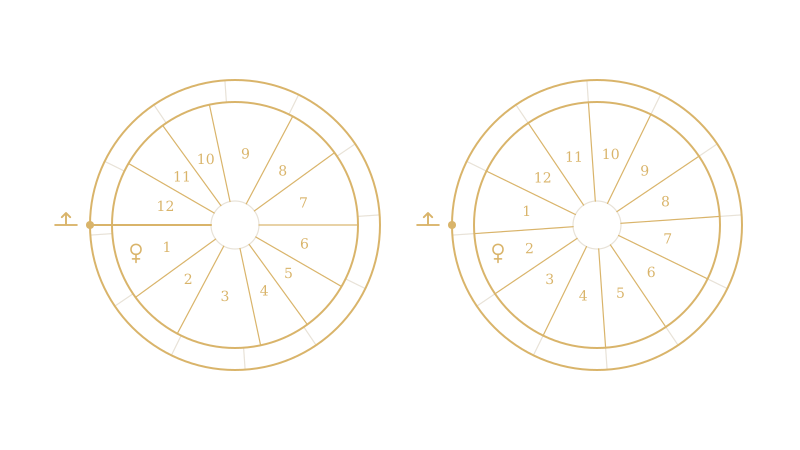
Take a chart with the Rising point at 25° Leo, the Sun at 10° Leo and Venus at 5° Virgo.
| Whole Sign | Equal | |
|---|---|---|
| The first house covers | 0° to 30° Leo | 25° Leo to 25° Virgo |
| Sun at 10° Leo | First house | Twelfth house |
| Venus at 5° Virgo | Second house | First house |
In Placidus and Koch the first house also begins at 25° Leo, so the Sun stands before it. Where that house ends depends on the birthplace.
Look at what did not move: the Sun is in Leo and Venus in Virgo in every column. A planet's sign comes from the zodiac layer, and no house system touches that.
Two kinds of planets tend to change house:
- Planets near a house border. A few degrees decide which side they are on.
- Planets in the Rising sign that stand before the Rising degree, like the Sun in the example. Whole Sign puts them in the first house, the other systems usually in the twelfth.
The later the Rising degree lies in its sign, the more Whole Sign differs from the other systems.
See your own chart
Enter your birth date and get your Sun, Moon and Rising sign explained. Free, in about 60 seconds.
I was born on
See my free previewWhat all house systems have in common
- The Rising sign. Every system starts from the same Rising point, down to the degree. How to find your Rising sign
- The planets in their signs. Sun, Moon and planets keep their signs and degrees, and the aspects, the angles between them, stay as they are.
- The meaning of the houses. The first house is read as self and appearance, the seventh as partnership, the tenth as career, in every system.
- The need for a birth time. The Rising point moves about one degree every four minutes, so a wrong birth time can move a planet into another house just as a change of system can. How to find your birth time
Which house system should you use?
There is no single right one, and astrologers disagree. Four practical rules:
- Stay with one system while you learn. Placidus is the usual starting point, because it is the most common.
- Try Whole Sign if you want the simplest picture. One sign, one house. It also works for a birth in the far north, where Placidus does not.
- If a planet changes house, read both houses. A planet close to a border is often read as active in both areas of life.
- Do not pick the system that gives the nicer answer. Ask which description you recognize in how you actually live.
Astrology describes tendencies, and the houses show where in life they tend to play out. A house system is a lens for that, not a verdict.
What to do next with your own chart
Check your birth time first. Then compare your houses in Placidus and in Whole Sign, and write down which planets change house. For those planets, read both house descriptions.
If you would rather have it read for you, a Birth Chart Reading is calculated from your exact birth data and describes your planets in their signs and houses.
Questions, answered
What is the most common house system?
Placidus is the most common house system in modern Western astrology. Whole Sign, the oldest system, is also widely used, and many astrologers compare the two.
Does my Rising sign change with the house system?
No. Every house system starts from the same Rising point, so your Rising sign and its exact degree stay the same. The signs of your planets stay the same as well.
Why is my planet in a different house in another chart?
Most likely the two charts use different house systems, or slightly different birth times. Planets close to a house border are the ones that move to the neighboring house.
Which house system is the most accurate?
There is no single most accurate one. They are different methods of dividing the same sky, and astrologers disagree about which works best. Pick one, learn it, and compare where a planet changes house.
Astrology is a tool for self-reflection, not a science, and it does not replace medical, psychological, legal or financial advice.
Keep reading

Planets & houses
The 12 houses in astrology, explained
The 12 houses in astrology are twelve areas of life, counted from your Rising sign. What each house means, what an empty house says, and why birth time matters.
6 min readRead more →
Sun, Moon & Rising
What is my Rising sign?
Your Rising sign is the zodiac sign on the eastern horizon at the minute you were born. What it means, what you need to find it, and why your birth time matters.
6 min readRead more →
Planets & houses
Empty houses in a birth chart: nothing is missing
Everyone has empty houses in their birth chart, because ten planets cannot fill twelve houses. What an empty house means and how to read it through its ruler.
6 min readRead more →
Start with your free preview
I was born on
See my free previewFree preview in 60 seconds · One payment · No subscription
For self-reflection and entertainment. Not medical, psychological, legal or financial advice.